Featured Post

FrontPage صفحہ اول

Salaam Pakistan  is one of projects of  "SalaamOne Network" , to provide information and intellectual resource with a view to...

Showing posts with label USA. Show all posts

Bernard Lewis, Zionists and Western Plans to Carve up Middle East and Pakistan. How to Counter these Anti Muslim Plans! اسلامی دنیا اورپاکستان کی تباہی کا منصوبہ – برنارڈ لوئس پلان


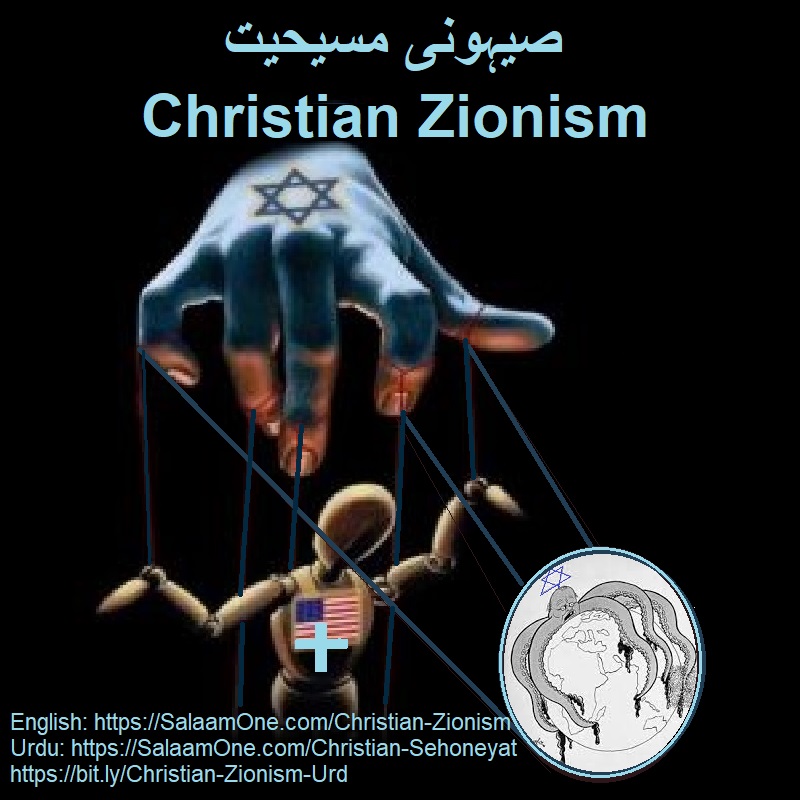
While turmoil and anarchy in the Middle East can be attributed the disunity among Arabs, the possibility of execution of well known Zionist plans supported by USA and West, to divide the Middle East in fragmented state lets cannot be ruled out. The “Bernard Lewis Plan” named after its architect Bernard Lewis, a specialist in ‘oriental studies’, the ‘history of Islam’ and the ‘interaction between Islam and the West’ is well known. Yet another  Zionist Plan for the establishment of greater Israel by dividing Middle East known as “Oded Yinon Plan”, also exists. Christian-Zionist lobby has heavy influence in politics and US government. Policies of Trump and earlier rulers clearly indicate US support for Zionism in Israel. The “Bernard Lewis Plan”, “Oded Yinon Plan” and “Christian-Zionism”, all “Three” are fully integrated to achieve their heinous designs against Muslims. ... Keep reading ..... [......]
Bernard Lewis, Zionists and Western Plans to Carve up Middle East and Pakistan. How to Counter these Anti Muslim Plans! اسلامی دنیا اورپاکستان کی تباہی کا منصوبہ – برنارڈ لوئس پلان https://bit.ly/BernardPlan

پاکستان کے ایٹمی ہتھیار مکمل طور پر محفوظ ہیں

~ ~ ~ ~ ~ ~ ~ ~ ~ ~ ~ ~ ~ ~ ~ ~ ~  ~ ~ ~  ~


~ ~ ~ ~ ~ ~ ~ ~~ ~ ~ ~ ~ ~  ~ ~ ~  ~
Humanity, Knowledge, Religion, Culture, Tolerance, Peace
انسانیت ، علم ، اسلام ،معاشرہ ، برداشت ، سلامتی 
Books, Articles, Blogs, Magazines,  Videos, Social Media
بلاگز، ویب سائٹس،سوشل میڈیا، میگزین، ویڈیوز,کتب
سلام فورم نیٹ ورک  Peace Forum Network 
Join Millions of visitors: لاکھوں وزٹرز میں شامل ہوں 
Salaamforum.blogspot.com 
سوشل میڈیا پر جوائین کریں یا اپنا نام ، موبائل نمر923004443470+ پر"وہٹس اپپ"یا SMS کریں   
Join 'Peace-Forum' at Social Media, WhatsApp/SMS Name,Cell#at +923004443470
     
  
Facebook: fb.me/AftabKhan.page

Questions about Pakistan’s ‘war on terror’ following the Taliban’s university attack

The terror attack on Bacha Khan University in northwest Pakistan which killed over 20 people wasn’t just a reflection of “how strong” the terror network continues to be locally. It also puts a big question mark on the logic of Pakistan’s “National Action Plan” (NAP) in the face of Islamabad’s upbeat assessments about the “success” of its counter-terrorism operations that began in 2014.

Rescue workers transport a wounded man to a hospital following an attack by gunmen on Bacha Khan University


Pakistan’s NAP is based on the concept of using force against all “types” of terrorists. However, the question we must ask is this: Can sole reliance on force be sufficient to counter terrorism? Years of counter-terrorism and counter-insurgency operations by US and NATO forces in Afghanistan have unambiguously proven that force alone cannot be theONLY OPTION in obliterating the kind of terrorism the region faces. This is the crucial lesson that Pakistan as well as Afghanistan’s “masters” are yet to learn.
As long as political power remains concentrated in the hands of the ruling elite—or security agencies for that matter–terrorism can’t be effectively tackled. As a matter of fact, the chief reason why terrorism flourishes in the Federally Administered Areas of Pakistan (FATA) is that this wild and remote tribal area has remained and continues to be politically excluded from the national Federation of Pakistan. The power vacuum created by this misstep is easily filled by rogue organizations such as Tehreek-i-Taliban Pakistan (TTP), which has accepted responsibility for yesterday’s university attack.
Since the start of the current phase of counter-terrorism operations by the North Waziristan agency of FATA, officials claim that scores of terrorists and numerous hideouts have been obliterated. Yet yesterday’s attack on Bacha Khan’s students was another tragic reminder of how hollow these official claims are.
The spuriousness of these claims is traceable to Pakistan’s flawed strategy vs. terrorism. One aspect of this failed strategy is the use of military courts and the reinstatement of the death penalty for terrorism-related offenses under NAP. What has this achieved?
What was clear then is incontrovertible now: The death penalty does not deter terrorism per se. On the contrary, it serves as a propaganda tool for the militants. This is underscored by the fact that more than one group besides the Taliban are  stepping forward to claim credit for the Bacha Khan attack. This is not to suggest that terrorists need not be punished for their crimes. The point is that merely punishing individuals is not effective.
University was deliberate target
Consider this: Bacha Khan University as a target and the day of the attack weren’t selected randomly. The tolerant, compassionate, inclusive politics of Abdul Ghaffar Khan (Bach Khan), a famous Pashtun political and spiritual leader after which the school was named, is what Pakistan ought to embody. The attack came as Bach Khan University was preparing to honor the day of their namesake’s death on Jan. 20. The institution represents a symbol of what the Islamic extremists are seeking to destroy.
While military operations seek to destroy the Taliban as a physical force, the very idea of the “Talibanism” also needs to be defeated. An idea, as the saying goes, can only be defeated by another idea. Pakistan, therefore, needs to rely on sources other than using force to “kill” the idea of ‘Talibanism.”
The first step in this campaign should be the empowerment of the people directly affected by the Taliban’s ideological as well as physical onslaught, argues veteran FATA agency participant, Abdul Fazal, who now lives “trapped” in one of the many slums of Islamabad, Pakistan’s capital.
“In the absence of state institutions and guarantee of protection of life and property of the people, fear of the Taliban overwhelms, leading to a silent yet virtual surrender of the people to the forces they cannot fight alone,”Abdul Fazal said. He added that powerlessness and fear either lead to surrender or flight to other cities in Pakistan. And it is precisely the inability to directly integrate people into the fight against terrorism that continues to keep Pakistan’s anti-terror “grand narratives” flawed.
Therefore, while Pakistan’s mainstream media reporting of the incident was littered with the so-called “rapidity” with which security agencies responded to and killed all terrorists in the university attack, hardly anyone seems to question the sorry state of Pakistan’s fight against terrorism.
Instead, the focus of all media reporting remained on the terrorists’ links to Afghanistan and India. While Pakistan and India continue repeatedly to blame each other for various terrorist activities, the Afghan-link does have some substance and needs to be examined carefully.
More than anything else, the Pak-Afghan border–a colonial legacy–is as much a part of the overall problem of cross-border terrorism and more efforts need to be focused there. The Afghanistan-Pakistan border is an anachronism that has been both a buffer against and a base for projecting power into Afghanistan for Islamabad. Now, with more than 150,000 Pakistani troops spread out across FATA as part of a protracted build up, the border has become perhaps the single-most immediate danger to both countries’ stability. It is a porous border. But should it necessarily remain so?
Deploying Pakistani troops in their thousands alone can’t prevent cross-border movement of terrorists. Nor can it be physically halted due to the nature of the terrain. However, what is feasible is better bilateral coordination of counter-terrorism efforts along the border. This co-ordination, however, needs to be extended into areas other than mere intelligence sharing. More than anything, both Pakistan and Afghanistan need to redirect their efforts in obliterating safe havens from where attacks are plotted and executed inside Pakistan and Afghanistan.
Recent incidents in both Afghanistan and Pakistan have highlighted the utmost need for greater regional co-operation. The fight against terrorism cannot be won, said an official from the Interior Ministry of Pakistan who asked not to be identified, unless the affected countries learn to co-ordinate their wars, with or without the co-ordination of the US and NATO forces. This is imperative since these foreign forces aren’t going to remain in the region for an indefinitely.
Islamic State in Pakistan
Pakistan and Afghanistan, therefore, need to restructure their relations against this scenario. The self-styled Islamic State (IS) has reportedly demonstrated a presence in Afghanistan. Some Pakistani officials, too, have acknowledged a rudimentary IS presence in Pakistan’s various urban areas.
The crucial need for Paksitan, therefore, is to “diplomatize” rather than “problematize” relations with Afghanistan. This requires local integration of all people involved in the war on terror as well as at the regional level (including Afghanistan) if the war on terror is to succeed.
Salman Rafi Sheikh is a freelance journalist and research analyst of international relations and Pakistan affairs. His area of interest is South and West Asian politics, the foreign policies of major powers, and Pakistani politics. He can be reached at salmansheikh.ss11.sr@gmail.com
Related:

Army chief vows to go to any length for a terror-free Karachi

Chief of Army Staff General Raheel Sharif has lauded the efforts of intelligence and law enforcement agencies for making Karachi peaceful city and vowed to go to any length for a secure and terror-free Karachi.

~ ~ ~ ~ ~ ~ ~ ~ ~ ~ ~ ~ ~ ~ ~ ~ ~  ~ ~ ~  ~
Humanity, ReligionCultureSciencePeace
 A Project of 
Peace Forum Network
Peace Forum Network Mags
BooksArticles, BlogsMagazines,  VideosSocial Media
Overall 2 Million visits/hits

Who wants peace in Pakistan?

6IN his final State of the Union address, US President Obama predicted a decade of instability in Afghanistan and Pakistan. Af-Pak was always a bad construct for policy formulation. There are obvious security linkages between Afghanistan and Pakistan. But the circumstances and prospects of the two countries are significantly different.

Predicting continued instability in Afghanistan is an easy call. The Kabul government is beset by internal division and an insurgency that has momentum. Given the preconditions posed by Kabul, the recently created quadrilateral forum will find it difficult to get the Afghan Taliban to the table let alone secure an agreement for peace. A turbulent and fractured Afghanistan is the most likely prospect for the foreseeable future.

Pakistan is a different story. It has undertaken a massive and comprehensive counterterrorism campaign targeting the TTP, sectarian groups and political gangs. Action has now been taken also against a rogue pro-Kashmiri organisation. Terrorist and criminal violence has been dramatically reduced.

There are several external drivers of violence that need to be neutralised.
Unfortunately, as illustrated by the assault on the Charsadda university, it is premature to celebrate. To break the back of terrorism in Pakistan, the kinetic campaign will need to be continued for a considerable period and the social, economic and other components of the National Action Plan fully implemented.

However, national actions will not be sufficient to defeat terrorism. There are several external drivers of violence that need to be neutralised.

The TTP is the self-confessed culprit in the Charsadda terrorist attack. With 180,000 troops deployed on its western borders, Pakistan has crushed or chased out most of the TTP militants from most of its territory. Small groups hide ‘in the open’, in inaccessible valleys or in Afghan refugee camps. However, the major threat arises from the infiltration of TTP terrorists from their safe havens in Afghanistan.

While Pakistan has offered to help in promoting reconciliation between Kabul and the Afghan Taliban, there is little evidence of reciprocal action by Kabul to eliminate the TTP safe havens or to control cross-border infiltration. Kabul has refused to even revive the coordination mechanisms for border monitoring that were created with the US-Nato command.

Certain circles in Kabul, such as the National Directorate of Intelligence, are known to have collaborated with the TTP and sponsored Baloch insurgents to destabilise Pakistan. They were also responsible for scuttling the Murree talks and then blaming Pakistan for escalated insurgent attacks from Kabul to Kunduz. Now, they are asking Pakistan to attack the Afghan Taliban unless they agree to come to the negotiating table. This would bring Afghanistan’s war to Pakistan.

Islamabad must reassert its demand for action against the TTP by Kabul and its international patrons. If such cooperation is not forthcoming, Pakistan will need to consider unilateral actions to eliminate the TTP safe havens in Afghanistan. Peace and security within Pakistan is also influenced by the policies and actions of several other external powers.

Historically, the US has contributed, wittingly or unwittingly, to Pakistan’s destabilisation since the anti-Soviet Afghan war. The rump US-Nato force in Afghanistan is essential to prop up the tottering Kabul government. Obama is wisely averse to resuming a larger military role in Afghanistan. A Republican president, however, may be more adventurist, especially if driven by the misplaced desire to counter China’s growing influence and interests in the region. In this context, it is relevant to evaluate whether the US shares China’s vision that peace and prosperity can be promoted in Pakistan and the region through the implementation of the China-Pakistan Economic Corridor.

India’s policies are more predictable. It has openly opposed the CPEC enterprise and is chary of China’s growing role in the region. Notwithstanding the Lahore embrace and the likely resumption of the Comprehensive Dialogue, India remains the godfather of anti-Pakistan elements in Afghanistan and can be expected to continue to encourage and support them in their use of the TTP and Baloch dissidents to spread mischief and turmoil in Pakistan. Since Pakistan is now constrained from playing the ‘Kashmir card’, it cannot hope to neutralise India’s subversive activities on the negotiating table; they will have to be defeated through direct action against the militants and muscular diplomacy with Kabul and its patrons.

Given Pakistan’s denominational composition, Iran’s policies will have an impact on Pakistan’s internal stability. Following its nuclear agreement with the major powers and the removal of international sanctions, Iran can be expected to remain on good behaviour on issues which do not affect its core interests. Tehran’s priorities are to retain its dominant influence in Syria, Iraq and the Levant; neutralise Saudi-led Sunni strategies, and maximise the economic benefits flowing from the lifting of sanctions. Iran can benefit from CPEC connectivity and closer linkages with China. However, Iran has a strategic relationship with India. A US-India-Iran axis is improbable, but not inconceivable. Pakistan needs to engage Iran and ensure that it does not try to play the sectarian card in Pakistan or attempt to forestall Pakistan’s emergence as China’s strategic link to the Arabian Sea and the Persian Gulf.

The GCC states have been Pakistan’s closest friends and benefactors. Relations were unfortunately frayed by the clumsy manner in which Pakistan spurned the Arab coalition that has intervened in Yemen. Since then, Pakistan has mended fences with Saudi Arabia. Similar conciliation with the UAE is outstanding. Some have conjectured that the UAE would consider Gwadar’s role in CPEC as a threat to Dubai’s commercial pre-eminence. In further exchanges with the GCC states, Pakistan should reassure them that CPEC will add, not detract, from their prosperity. But Islamabad’s first priority should be to secure an effective end to the flow of funds to sectarian and extremist groups from certain Gulf states.

It is only through such full-spectrum diplomacy, defence and deterrence that Pakistan can prove Obama wrong and achieve the peace and stability which is indispensable to implement the CPEC, realise rapid growth and emerge as Asia’s newest economic ‘Tiger’.

Who wants peace in Pakistan?
By MUNIR AKRAM; former Pakistan ambassador to the UN.
http://www.dawn.com/news/1234994/who-wants-peace-in-pakistan

US exploring deal to limit Pakistan’s nuclear arsenal

7The Obama administration is exploring a deal with Pakistan that would limit the scope of Pakistan’s nuclear arsenal, the fastest-growing on Earth. The talks are the first in the decade since one of the founders of its nuclear programme, Abdul Qadeer Khan, was caught selling the country’s nuclear technology around the world. The talks are being held in advance of the arrival of Prime Minister Nawaz Sharif in Washington next week. They focus on American concern that Pakistan might be on the verge of deploying a small tactical nuclear weapon — explicitly modeled on weapons the United States put in Europe during the Cold War to deter a Soviet invasion — that would be far harder to secure than the country’s arsenal of larger weapons. Read: Pakistan likely to secure civil nuclear deal with US: report But outside experts familiar with the discussions, which have echoes of the Obama administration’s first approaches to Iran on its nuclear programme three years ago, expressed deep skepticism that Pakistan is ready to put limits on a program that is the pride of the nation, and that it regards as its only real defense against India. The discussions are being led by Peter R Lavoy, a longtime intelligence expert on the Pakistani programme who is now on the staff of the National Security Council. At the White House on Thursday, Josh Earnest, the press secretary, was asked about the talks and broke from the administration’s previous position of refusing to comment. “A deal like the one that’s been discussed publicly is not something that’s likely to come to fruition next week,” he said. “But the United States and Pakistan are regularly engaged in a dialogue about the importance of nuclear security. And I would anticipate that that dialogue would include conversations between the leaders of our two countries.” The central element of the proposal, according to other officials and outside experts, would be a relaxation of strict controls put on Pakistan by the Nuclear Suppliers Group, a loose affiliation of nations that tries to control the proliferation of weapons. Read: Pakistan’s nuclear arsenal could become world’s third-biggest: report “If Pakistan would take the actions requested by the United States, it would essentially amount to recognition of rehabilitation and would essentially amount to parole,” said George Perkovich, vice president for studies at the Carnegie Endowment for International Peace, who has maintained contacts with the Pakistani nuclear establishment. “I think it’s worth a try,” Perkovich said. “But I have my doubts that the Pakistanis are capable of doing this.” David Ignatius, a columnist for The Washington Post, first disclosed the exploratory talks in a column a week ago. Since then, several other officials and outside experts have talked in more detail about the effort, although the White House has refused to comment. The activity of Abdul Qadeer Khan, who lives in retirement in a comfortable neighborhood in Islamabad after many years of house arrest, prompted more than a decade of American-led punishment of Pakistan’s nuclear enterprises. He ran what amounted to the world’s most sophisticated black market in the equipment needed to make nuclear fuel, and he did business with Iran, North Korea and Libya. When Libya turned over the equipment it bought, in late 2003, it included a nearly complete design for one of China’s first nuclear weapons. Read: No choice: Pakistan obliged to develop nukes, says Aizaz Pakistani officials denied that any of the country’s leaders knew of Qadeer Khan’s black market activities, a story American officials did not believe because some of the equipment was shipped on Pakistani Air Force cargo planes. While Qadeer Khan is not under formal restrictions today, he has not left Pakistan in years and has been prohibited from talking to most outsiders. Even before entering office, President Obama was interested in addressing the Pakistani nuclear problem, considered by most proliferation experts to be the most dangerous in the world. But until now, most efforts to manage the problem have been covert. During the Bush administration, the United States spent as much as $100 million on a highly classified program to help secure the country’s nuclear arsenal, helping with physical security and the training of Pakistani security personnel. Those efforts continued in the Obama years, with State Department, Energy Department and intelligence officials meeting secretly, in locales around the world, with senior Pakistani officials from the Strategic Plans Division, which controls the arsenal. They used those sessions to argue to the Pakistanis that fielding the small, short-range nuclear weapons, which Pakistan designed to use against an invading Indian ground force, would be highly risky. Read: Pakistan seeking US cooperation on civil nuclear energy American officials have told Congress they are increasingly convinced that most of Pakistan’s nuclear arsenal is under good safeguards, with warheads separated from delivery vehicles and a series of measures in place to guard against unauthorised use. But they fear the smaller weapons are easier to steal, or would be easier to use should they fall into the hands of a rogue commander. “All it takes is one commander with secret radical sympathies, and you have a big problem,” said one former official who dealt with the issue. The message appears to have resonated; an unknown number of the tactical weapons were built, but not deployed. It is that problem that Lavoy and others are trying to forestall, along with preventing Pakistan from deploying some long-range missiles that could reach well beyond India. But American leverage has been hard to find. Unlike Iran, Pakistan never signed the Nuclear Nonproliferation Treaty, the international agreement that prohibits nations, except for existing declared nuclear states like the United States, from possessing a nuclear arsenal. Pakistan is not alone in that distinction: India and Israel also have not signed. (North Korea has twice declared that it has withdrawn from the treaty, in 1993 and 2003.) Ordinarily, any country’s refusal to sign the treaty would preclude American nuclear cooperation. So Pakistani officials remain angry with the American decision to enter an agreement with India in 2005 allowing India to buy civil nuclear technology, even though it remains outside the treaty and put no limits on its nuclear programme. Read: US providing precision strike technology to Pakistan: Jilani Under that agreement, India’s nuclear infrastructure was split with a civilian program that is under international inspection, and a military programme that is not. Pakistani officials have demanded the same arrangement. That does not appear to be on the table. Instead, the United States is exploring ways to relax restrictions on nuclear-related technology to Pakistan, perhaps with a long-term goal of allowing the country to join the Nuclear Suppliers Group, which regulates the sale of the technology. That would be largely symbolic: Pakistan manages to import or make what it needs for its nuclear arsenal, and China has already broken ground on a $9.6 billion nuclear power complex in Karachi. PM Nawaz presided over the ceremony.

US exploring deal to limit Pakistan’s nuclear arsenal By David E Sanger
Tribune.com.pk
This article is in partnership with The New York Times.

Why The World Is Spinning Into Crisis Everywhere?

Israel vs. Hamas. Ukraine vs. Russia. Unaccompanied minors at the Texas border. Syria in flames, with a militant “caliphate” at the door. Iran stalling for time on nukes. A rising China sowing fear throughout the rest of Asia.
The world seems dangerously unmanageable these days.
President Barack Obama is paying a political price at home, with 55 percent of Americans polled by Pew now disapproving of his handling of foreign affairs -- a dramatic reversal from 2009, when his approval rating was 56 percent. While experts argue about how much Obama and his policies are really to blame, the truth is that he occupies the Oval Office at a time of historic flux and of diminished clout, not only for the U.S. but also for the idea of a dominant global power.
To understand that, you need to revisit an influential article published in Foreign Affairs in 2008 by Richard Haass. It’s called “The Age of Nonpolarity,” and Haass wrote it as he was advising presidential candidates behind the scenes in both parties.
Advertisement

AdChoices
Haass, the longtime president of the nonpartisan Council on Foreign Relations (and before that a staffer for President Jimmy Carter and the two Bushes), painted a grim picture of an unsettled, chaotic and dangerously diffuse world Familiar methods of diplomacy, statecraft and war had become feeble, if not useless, in the 21st century, he wrote. The ages of “unipolar” power (i.e., a dominant United States) were over; so were the times of “multi-polar” power, such as the first half of the 20th century.
Now the world faced a free-for-all in which “non-state actors” -- terrorists, global corporations, religious and ethnic tribes, sovereign wealth funds and nonprofit charities, to name a few -- were as crucial as countries in shaping the order of a “nonpolar” world.
To be clear, non-state actors -- which also include alliances such as the United Nations and the European Union, "civil society" foundations and academic institutions -- could be forces for healing as well as mayhem. As Haass noted more recently to The Huffington Post, "If you are talking about education or health care globally, for example, it wouldn't make any sense not to have the Gates Foundation involved." But still these new entities do not follow the familiar playbook of nations.
The Internet and international floods of capital were empowering these non-state players, Haass wrote in 2008. No nation or set of nations was “in charge.” Ethnic, religious and regional rivalries had been set free by the weakness of nation-states, and by an Internet that enables digital forces who couldn't care less about the wisdom of Metternich or Gorbachev-Reagan diplomacy.
The U.S. had to figure out how to operate in this new world, in which my-way-or-the-highway wouldn’t work, and neither would traditional nation-to-nation “talks,” Haass wrote. Military power would be just as important as before, he wrote, but it would have to be shrewdly and surgically applied, and almost always in concert not only with other countries but with other non-state players.
Although Haass had spent many years working for Republicans, his article caught the eye of then-Sen. Obama. Early in his presidency, Obama journeyed to Cairo to give a speech designed to reach out to the Islamic world and, in doing so, to enunciate the core of his own global theory. He declared that the real America did not fit the “crude stereotype of a self-interested empire” -- and certainly would not do so while he was in charge.
The new interdependence of the world, the president said, was in conflict with a “human history [that] has often been a record of nations and tribes subjugating one another to serve their own interests.
“Yet, in this new age, such attitudes are self-defeating,” Obama said. “Given our interdependence, any world order that elevates one nation or group of people over another will inevitably fail. So whatever we think of the past, we must not be prisoners of it. Our problems must be dealt with through partnership; progress must be shared.”
It was an idealistic, uplifting message -- and one that seemed to fit the changing times described by Haass. Four months later, officials in Norway announced that they were giving Obama the Nobel Peace Prize.
Six years after he wrote his original article, Haass is busy writing another, and it's an even more timely call for a new understanding of how to manage world crises. The evidence that we need to do better is in the headlines and the videos.
“Things have gotten much worse,” he told HuffPost. “It’s even more urgent that we figure out a new form of world governance, because the old ones don’t work.”
The disruptive forces he wrote about before have become more potent and unsettling, and President Obama, while he understands the challenge, hasn’t always executed as well as he could have, Haass said. There's a rising factor Haass didn’t predict: the waves of immigrants and refugees “within nations and between them,” who are not easily dealt with by traditional diplomatic or military methods.
“I’m updating the piece,” he said, for a world that is now at nonpolarity plus.
The tangled flare-ups around the world are made more intractable by the fact that one leader can’t phone another and cut a deal that guarantees results. The organizing principals are in flux. Consider these trouble spots:
Israel and Hamas. Once upon a time, the lid was kept on the Levant largely by two great powers, the U.S. and Saudi Arabia. Those days are over, thanks to Shia sectarianism, Sunni terrorism in the form of al Qaeda and now the Islamic State in Iraq and al-Sham (ISIS), and the Israelis’ growing willingness to ignore U.S. pressure.
Ukraine and Russia. Ever unsure of its identity, Russia is once again on the march, albeit not as in the days of uniformed soldiers driving tanks into Slavic city squares. President Vladimir Putin has empowered Ukrainian separatists whom he can’t quite control, with disastrous results.
Two major petro-theocracies. One is Iran, the other Saudi Arabia. Old-style notions of statecraft don’t rule these two oil-rich players. Instead, they are the modern spear points of a 14-centuries-long sectarian war, in which religion is nationhood.
“The Caliphate.” Nothing demonstrates the deterioration of the very idea of “nation” more than the pop-up caliphate declared by ISIS. Sunni insurgents have seized territory in Syria and Iraq, the modern borders of which were drawn by the so-called Great Powers a century ago.
According to Haass, the Far East is the only region where world affairs are being conducted along old lines. “The China situation is the most traditional,” he said. It's a rising major power dealing with its longtime regional rivals.
But even in and around China, there are non-state players and problems. China is exporting tens of thousands of its own workers throughout Southeast Asia, an international business model that is causing friction in Vietnam and Cambodia. And the People’s Republic is being harassed on its western flank by Islamic separatists, who want nothing more -- or less -- than the freedom to worship as they wish.
China’s rulers have responded with a vicious military crackdown.
But that method won’t work in the rest of the world anymore. It may not even work in China.

Why The World Is Spinning Into Crisis Everywhere
By  Howard Fineman Global Editorial Director
http://m.huffpost.com/us/entry/5614634

America's Pakistan Policy Is Sheer Madness


This week, the Congressional Research Service published a list of all major U.S. arms sales and grants to Pakistan. Washington claims that these transfers enable Pakistan to be better a partner in the U.S.-led war on terrorism. The evidence belies these claims. In fact, Pakistan undercuts key U.S. interests in the region and it perdures as a source of Islamist terrorism at home and abroad. The items that Washington has conveyed to Pakistan have little utility in fighting insurgents and terrorists; rather, they enable Pakistan to better fight India, a democratic American partner that has long endured Pakistani predations. A new American policy towards Pakistan, rooted in sober realism, is long overdue.

Since 9/11, the United States has lavished Pakistan with nearly $8 billion in security assistance, $11 billion in economic assistance, and $13 billion in the lucrative program known as Coalition Support Funds (CSF). Since then, Pakistan has availed of significant U.S. weapons systems and armaments, including: a used Perry-class missile frigate; 18 new and 14 used nuclear-capable F-16s; an array of munitions (i.e. 500 air-to-air missiles, 1,450 2,000-pound bombs);  1,600 kits that allow Pakistan to convert gravity bombs into laser-guided smarter bombs, 2,007 anti-armor missiles, 100 Harpoon anti-ship missiles, 500 Sidewinder air-to-air missiles, seven naval guns, 374 armored personnel carriers, and much more. A transfer of 15 reconnaissance unmanned aerial vehicles is also under way. This list suggests that Pakistan’s insurgents have developed air, naval and ground-force capabilities.

What tangible benefits has Washington secured for these emoluments? Very few it appears. Victory in Afghanistan was long ago lost. Pakistan is more unstable than ever. Even though Washington justified this largesse in terms of securing Pakistan’s cooperation in the Afghan war, Pakistan unrelentingly supports the Afghan Taliban, which has killed 2,356 U.S. military personnel, and is responsible for 677 coalition military deaths, as well as the deaths of thousands of civilian contractors (for whom there is no official count), more than 21,000 Afghan civilians since 2001, and more than 20,000 Afghan police and army personnel since 2003. Insurgents killed more than 5,000 ANSF in 2014 alone. Pakistan continues to support the Jalaluddin Haqqani network, which launches sophisticated suicide operations against U.S., NATO, Afghan and Indian targets in Afghanistan. Without Pakistan’s direct military, diplomatic, political and financial support—as well as secure sanctuaries—in Pakistani territory, the insurgents would not be as lethal or as capable as they are. And, of course, Osama Bin Laden was discovered a short distance from Pakistan’s famed military academy at Kakul. Pakistan has not even bothered to investigate who facilitated his tenure in the country. Apparently, this is what cooperation looks like.

These U.S. policies towards Pakistan have guaranteed a more dangerous world for several reasons. 

First, this assistance better situates Pakistan to wage war against India while doing nothing to shape Pakistan’s will or capabilities to target terrorists and insurgents. This should vex Americans, Indians, Afghans and even ordinary Pakistanis who are the terrorists’ most common victim.  

(Recommended: 5 Indian Weapons of War Pakistan Should Fear)

Second, U.S. efforts to bolster Pakistan’s ability to fight its rebelling clients are stymied by the simple fact that Pakistan continues to create terrorists while fighting a selective war against others. Pakistani soldiers and citizens are dying at the hands of recalcitrant elements of the Pakistani Taliban, yet the deep state continues to churn out “good terrorists” such as Lashkar-e-Taiba (now operating under the names of Jamaat-ud-Dawa and Filah Insaniyat Foundation) and Jaish-e-Mohammad. It even tolerates sectarian killers who reliably mow down any Shia who may be suspected of being a “fifth column” for Iran.
Keep reading  http://nationalinterest.org/feature/americas-pakistan-policy-sheer-madness-12894

Videos:
https://www.google.com.pk/search?q=christine+fair+America%27spakistan&num=50&newwindow=1&client=ms-android-samsung&espv=1&source=lnms&tbm=vid&sboxchip=Videos&sa=X&ei=_Y1ZVfPRHsWqywPngYHwBg&ved=0CAgQ_AUoAg&biw=360&bih=559

Peace and You ?


The world is in turmoil; mass killing, genocide, ethnic cleansing, occupation of Muslim lands for natural resources, oppression, expulsions, deprivation and exploitation of innocent, Muslims by power hungry corrupt despotic rulers, greedy powerful countrymen, extremist religious groups and Neo-colonial powers has reached unprecedented level. People are perplexed, they want to get out of this quagmire but there is no way out in sight.

The quest for "Peace and Justice" is exploited by foreign sponsored extremist in the name of religion to recruit Jihadists for power, plunder and exploitation. It adds fuel to fire and provide lame excuse, justification for more oppression and killing of Muslims by the enemies of humanity.

Most of Muslim rulers & leadership have been entangled to tacitly serve agenda of hostile powers, just to protect their rule. The Muslim countries which were relatively strong and wealthy have been systematically dragged in to sectarian, ethnic & tribal civil war and breakup, thus adding fuel to fire.
World peace is not achievable while 1.5 billion Muslims, rich in culture, history and resources are kept in state of turmoil, none will be secure and safe. Hence there is need for the intellectuals, thinkers and all those feeling distressed, to come forward to work out short and  long term "Methodology for sustainable  Peace" to meet the challenges at present and future. It shall help to make a safe and peaceful world for the humanity.
For comments, suggestions via message. visit: 
http://www.facebook.com/pages/Peace-Forum/145301398882741
http://www.facebook.com/aftabkhaan


* * * * * * * * * * * * * * * * * * *
Humanity, Religion, Culture, Ethics, Science, Spirituality & Peace
Peace Forum Network
Over 1,000,000 Visits
* * * * * * * * * * * * * * * * * * *

Security Challenges for Pakistan

Pakistan’s security forces may be fighting with one hand tied behind their back. Some of Pakistan’s most vocal ‘democrats’ seem to take pride in denigrating their own country’s armed forces while remaining silent or ignorant about the actions of Pakistan’s adversaries. The differences between the civilian and military leadership are out in the open.

In the challenging environment emerging in the region, Pakistan needs to evolve a clear plan to preserve its security and safeguard its interests.

The first priority is to militarily defeat and politically divide the TTP and make peace only on terms that respect Pakistan’s Constitution, sovereignty and territorial integrity. Both the Afghan Taliban and the Americans should be asked to support this effort or get out of the way.

Second, Pakistan should seek peace with and within Afghanistan. This can be achieved only from a position of strength. Kabul should be asked to end its support for the TTP and the BLA. Pakistan may need to demonstrate its influence with the Afghan Taliban to secure Kabul’s cooperation. Meanwhile, opening a dialogue with the Northern Alliance could lay the ground for a future deal.

Third, the intercession of the US, China and Russia should be sought to build a regional consensus, incorporating Iran and Saudi Arabia, for peace within and around Afghanistan. Despite their escalating rivalries in Europe and East Asia, each of them has an interest in pacifying Afghanistan, not least to counter global terrorism.

Finally Pakistan’s difficult relationship with India will need to be managed through a combination of deterrence and diplomacy. The major powers also have a stake in preventing a major crisis between nuclear-armed India and Pakistan. They can be persuaded to temper Modi’s anticipated belligerence.

The success of such a plan can be assured only if Pakistan’s political leaders, security forces and diplomats work cooperatively to realise these national objectives.

By Munir Akrsm, a former Pakistan ambassador to the UN. Dawn.com

Pakistani Conspiracy Theories

Free%20Books%20%26%20Articles

Conspiracy theories have long flourished in Pakistan. One Pakistani newspaper editor has quipped that they constitute the country’s only growth industry. It’s easy to understand why: they’re planted in educational curriculums, propagated by a powerful security establishment, promulgated by influential religious leaders, and peddled by wildly popular private television channels—all in an environment where facts and transparency are often elusive.
Yet, there’s another reason for the popularity of Pakistani conspiracy theories: many contain kernels of truth. And unfortunately, these tend to be about the United States. Here are four in particular that aren’t as cockamamie as they may seem. Keep reading >>>>>
* * * * * * * * * * * * * * * * * * *
Humanity, Religion, Culture, Ethics, Science, Spirituality & Peace
Peace Forum Network
Over 1,000,000 Visits
* * * * * * * * * * * * * * * * * * *

In War on Terror, Pakistan Piles Up Heavy Losses


Pakistan's Army Has Lost Roughly Twice as Many Soldiers in the Conflict with Taliban Fighters as the U.S.
Cpl. Hamid Raza, right, helps Cpl. Mohammed Yakub at a Rawalpindi hospital full of casualties of Pakistan army battles against the Pakistani Taliban. Each day, Cpl. Hamid Raza helps strap Cpl. Mohammed Yakub to a physiotherapy bench, lifts it and wipes the sweat off his bewildered comrade's forehead. Eyes darting, Cpl. Yakub often screams and grunts through the procedure, flailing his hands.
[​IMG]
"Traumatic head injury," Cpl. Raza says softly. "He realizes it's me, and he tries to speak, but he can't. He can't eat, he can't talk, he can't remember the words."
Both men are fortunate to be alive. A year ago, a Taliban roadside bomb hit a truck ferrying Pakistani soldiers from Cpl. Raza's 18th Punjab Battalion after a troop rotation in the North Waziristan tribal region on the Afghan frontier. Seventeen men were killed, and only a handful survived. It was their first home leave.
The Pakistani army has lost roughly twice as many soldiers in the conflict with Taliban fighters as the U.S. It is a toll that keeps rising as American forces prepare to withdraw from next-door Afghanistan by December amid an intensifying war on both sides of the border. Keep reading >>>>>>


    ---------------------------------------------------------------
    Peace Forum Network
    Humanity, Religion, Culture, Ethics, Science, Spiritually & Peace

Pakistan & geopolitical realities

Unsurprisingly, Pakistan’s place in the world was discussed at great length at the KLF. Compared to the year before, when impending national elections loomed over discussions, and a tired relationship with the United States as usual held court, this year the focus shifted to Pakistan as a potentially powerful player in the region.
It was urged time and again that Pakistan needs to take steps to make decisions necessary for the stability of the state and consequently the region. As stipulated by Maleeha Lodhi in a session titled ‘Afghanistan 2014: Consequences for Pakistan,’ the tyranny of geography sets Pakistan in a position where it cannot “wish Afghanistan away.” Another sentiment was echoed by Ishrat Hussain: if there is no “Af” what is to become of “Pak” in the Af-Pak equation, as referred to by the US.

The impending drawdown of Nato-led forces in December 2014 was therefore a prime topic of discussion, as foreign relations experts and diplomats weighed in on the region’s history and the road ahead.

In a session titled ‘Geo-Political Equation: Pakistan in the World,’ senior diplomat Zafar Hilaly pointed out that peace in Afghanistan only stands a chance if “underpinned by both the US and Pakistan,” urging that Pakistan cannot afford to continue on its path of disassociation with an erratic ally. Ashraf Jehangir Qazi, former ambassador to the US, set out an even more dire scenario, putting Pakistan’s “dysfunctional state of affairs” into focus from which one cannot possibly develop a “coherent foreign policy.” With Pakistan’s population to reach 350 million by 2050, less than 50 per cent education rate, precarious food security and encroachment by the Tehreek-i-Taliban Pakistan (TTP) are only part of Pakistan’s problems.

Dr Hussain set out the scenario of Pakistan’s troubled relationship with the US dating back more than 60 years, in a session with US Ambassador Richard Olson titled ‘The US-Pakistan Relationship: Will it Endure?’ Ambassador Olson, who assured audiences of the importance of Pakistan as a regional ally, specified that the US has a vested interested in Pakistan not based on just 2014 but 2050, when Pakistan will be the world’s 4th most populous nation and an important player in the region. The ambassador, although reassuring overall, remained reticent and evasive regarding pressing issues, giving no specific response about aiding Pakistan to become economically independent via trade.

What was notable, though, were the audiences who not only came out in droves to packed sessions, but asked bold and scathing questions that spelt out US intentions far more lucidly. The sanctions on Iran were stipulated as paramount — more so than Pakistan’s dire energy needs — while high tariffs (roughly 18 per cent) on Pakistan’s textile exports were not looking to be lowered anytime in the foreseeable future. Both these points were brought up by the audiences, overpowering moderators who generally kept the discussions well-moderated.

What made the discussions different from last year were the ground realities spelt out for Pakistan following the drawdown. The possible influx of more than two million refugees due to a porous border and lack of bounds to the strategic depth created by the TTP in Pakistan’s northwest province, are some of these realities. In fact, Pakistan was urged by Riaz Mohammad Khan, former foreign secretary, to repel becoming “custodians for spokespersons for Taliban.”

Additionally, problems within Afghanistan were also highlighted, with unemployment, poverty and the possibility of civil war among them.

What made it a crucial year to discuss the drawdown was that the effects of 1996 still resonate strongly in the minds of officials and civilians alike. In the session ‘Afghanistan 2014,’ Lodhi urged officials to approach interlocuters of the Taliban in order to avoid a violent takeover by the Taliban in 2015. How to avoid that power vacuum was one of the other burning questions discussed during the session.

But what speakers succeeded in setting out for the audiences, they were unable to offer solutions for. For example, thrown into the mix of the drawdown is the High Peace Council that President Hamid Karzai has created, but has no faith in. The bilateral security agreement, central to a peaceful drawdown, is also not expected to be signed by Karzai. In fact, according to news reports, Karzai is said to have been in talks with the Taliban for months, trying to chart out his own deal with them, thus his reluctance to sign the peace agreement, leaving again US relations with Afghanistan in a lurch and US drawdown at a standstill. Above all, as mentioned by Qazi, the peace talks with the TTP were challenged as a farce, set up by the government and parties as “designed to go nowhere.”

What audiences did find respite in, however, was the acknowledgement by Ambassador Olson of the US playing a role in the “seeds of 9/11”. A little too late, though, with Pakistan already a hotbed of militant regrouping.
BY: FAIZA VIRANI
http://www.dawn.com/news/1087206/5th-karachi-literature-festivalpakistan-geopolitical-realities
~~~~~~~~~~~~~~~~~~~~~~~~~~~~~~~~~~~~~~~~~
  1. WELTANSCHAUUNG - Pakistan's Geographical Importance - YouTube

    www.youtube.com/watch?v=eLWMKmyTOS0
    This docu-presentation is based on a paper read by Saleem Aziz Khan at the Social Intervention Conference ...
  2. Geography of Pakistan - YouTube

    www.youtube.com/watch?v=HprS6w06OsQ
    TO CARRY OUT AN OVER VIEW OFGEOGRAPHICAL AND GEOPOLITICAL IMPORTANCE OF PAKISTAN, WITH SPEC EMPHASIS ON ITS  ...
  3. LiveLeak.com - Turkey-Pakistan Relations: A Transformational View (Part-1)

    www.liveleak.com/view?i=b07_1340014575
    Since 2 April 1954 when Pakistan and Turkey signed a treaty of ... Turkey and Pakistan retained their geo-political importance in the post cold  ...
  4. Geopolitical importance of Persian Gulf-Iran Today-05-15-2012 - YouTube

    www.youtube.com/watch?v=l8VqiYsnTdU
    ... a body of water with great geo-economic andgeopolitical importance. ... goals of the Anglo-American Empire in Afghanistan Pakistan Iranby ...

Free-eBooks: http://goo.gl/2xpiv
Peace-Forum Video Channel: http://goo.gl/GLh75