Featured Post

FrontPage صفحہ اول

Salaam Pakistan  is one of projects of  "SalaamOne Network" , to provide information and intellectual resource with a view to...

Showing posts with label War. Show all posts

Pakistan Delusions


Pakistan's Delusions: Navigating Reality amid Challenges
Pakistan, a nation of diverse cultures and a rich history, has at times found itself grappling with what can be described as "delusions" – a term that captures the challenges of unrealistic perceptions and aspirations. While these delusions may stem from various sources, they have implications that extend beyond mere misconceptions.

One such delusion has been the belief in quick fixes for complex issues. Pakistan's journey has often been marked by a search for instant solutions to deep-rooted problems, be it economic disparities, social inequality, or political unrest. This inclination has hindered the development of sustainable and comprehensive strategies, perpetuating a cycle of unmet expectations.

Another delusion lies in the tendency to externalize blame. While external factors can undoubtedly influence a nation's trajectory, an overemphasis on blaming external entities for internal challenges can impede self-accountability and hinder genuine progress. It is crucial for Pakistan to acknowledge its internal dynamics and work collaboratively to address them.

Furthermore, there exists a geopolitical delusion, where aspirations for regional dominance sometimes overshadow the need for constructive diplomacy and peaceful coexistence. Striking a balance between national interests and global responsibilities is essential for fostering stability and positive relations.

These delusions, however, do not define the entirety of Pakistan's narrative. The nation's resilience, resourcefulness, and potential for growth shine through the clouds of uncertainty. By acknowledging and addressing these delusions, Pakistan can chart a more realistic and prosperous path forward.

In essence, the key lies in embracing a pragmatic approach, grounded in a clear understanding of the challenges at hand. By addressing delusions, Pakistan can harness its vast potential, fostering a future that aligns with its rich heritage and global aspirations.


Debt of Freedom: https://bit.ly/Partition47

Let's Save Pakistan & Pak Army

While Pakistan has been brought to the brink of political and economic disaster, should we keep watching as silent spectators? 

The job of the army is to defend the country & the people and to sacrifice their lives in the fulfillment of this noble duty, the martyrs are already giving their blood and lives every day.

Soldiering has been a prestigious and respected profession for centuries. Prophet Muhammad () was also a great General to be emulated.

Its NOT the job of the Pak Army is to make themselves dirty with political filth.

Soldiers do not trade their honor and pride for petty gains. Pak Army need to remain prestigious as ever.

There is urgent need of result oriented dialogue among three main pollical power players to find amicable political and economic solution.

We have to raise our voice and do every possible effort within law to force them to do it for Pakistan.

In these circumstances, it is important that patriotic people come forward and establish pressure groups, big or small, with only One Point Agenda; Save Pakistan, talk only about Pakistan without affiliation to any political party.

Urge consultation and dialogue among all.

Insist on finding solutions to problems through dialogue (شوری)

"...who conduct their affairs with consultation ( وَأَمْرُهُمْ شُورَىٰ بَيْنَهُمْ) among themselves" (Quran 48:38)

No one should try to impose his will on others, this mind set is root cause of disaster. Consider all the logical arguments to find solution.

The Pak Pressure Groups should include intellectuals, professors, economists, businessmen, doctors, engineers, youth, students, religious people, workers, farmers, landlords, retired bureaucrats & military officers, citizens of every class. creed or faith. They should protest in every city, town, region, social, print and electronic media to build up pressure on the powerful elite to find ways to get Pakistan out of the current political and economic quagmire.

Silence is not our choice, we have an obligation, duty, its our responsibility ordained by Allah and the Messengerof Allah (Quran 8:25, 7:164-165, details follow)

Being a silent spectator today is crime against Pakistan and grave sin.

https://bit.ly/SavePak

  • Let's #SavePakistan 🇵🇰 Let's #SavePakistan Army 🇵🇰
  • Rise and fall of Nations – Law of Quran 
  • قرآن کا قانون عروج و زوال اقوام
  • https://bit.ly/NationsRiseFal


WHY DO MARTIAL LAWS FAIL? 

Ikram Sehgal, the renowned defence and political analyst in his article ”Why martial laws go horribly wrong quoted his earlier  article of June 29, 1995, ‘Why do martial laws fail?’ He writes:

“Martial laws/ Hybrid Regimes fail because the initiators of all extra-constitutional rule ride into town on tanks with the lofty aim of saving the country, relying on that platonic national purpose to make themselves credible. They soon adjust the aim to more material (and less patriotic) reasons of self-perpetuation. The original aim remains publicly the same, and becomes an exercise in self-delusion. 

This diversion of aim means that one individual or group is simply replaced by another (or others), instead of being a transition mechanism that provides for and facilitates the process of the democratic system being repaired and renovated to reflect the real genius and aspirations of the people. 

Martial laws fail because the armed forces get themselves involved in mundane, routine bureaucratic duties that they are not supposed to be involved in. 

Martial laws fail because those who impose martial laws do not have correct knowledge about the working of the state or the individuals who run it, and soon surround themselves with sycophants who are usually holdovers from previous governments.” When he imposed his form of martial law in 1999, Musharraf had no intention of heeding this advice rendered in print as far back as 1995. One doubts any future military dictator will; power is a great aphrodisiac.

By the time Musharraf exited, the army’s name was in mud within the country, and outside. Where once the uniform was worn with pride, it became a target of public anger and scorn. (striking resemblance to present, look at Army image building campaign in the media to calm down angry public) Rumor had it that somehow the army’s image had to be reinstated in public eyes. 

Why is Corrupt Political Leadership Installed by the Military?

Instructors in army schools of learning are called ‘Directing Staff’ (DS). Students plan out various alternatives; the ‘plan’ the instructors prefer is called the “DS solution”. To bring the army back from the dumps, the DS solution was to have a predictably corrupt political leader in place against whom all the collective public venom would be directed, and this would deflect public anger away from the army. The calculated risk was that he would not change, but if he did, even that would be counted as a plus. Zardari helped considerably by his recent Nero-like presidential jaunt to London and Paris while the country drowned. This confirmed him as easily the most hated person ever in Pakistan’s history. He couldn’t care less; such revulsion has never really bothered him. 

The army’s success in counter-insurgency (COIN) operations, achieved through great sacrifice in blood by all ranks, was a major turnaround for the army’s image. The massive flood relief effort is acting as a force-multiplier bonus to bring the army back to its pedestal in public eyes.

With both positive and negative lessons learnt from the 1999 Pakistan and 2006 Bangladesh military interventions, a refined ‘Pakistan model’ must still remain the route of last resort. 

Uniformed personnel have no business running the government (or for that matter businesses); they must support the honest and capable in governance. Martial laws with platonic intentions end up perpetuating individual rule, as happened in Musharraf’s case, and can go wrong, horribly, horribly wrong.

Readers may draw parallels with  present mess.

  1. Milpolitik, Hybrid Politics (denied by the military but ground realities prove otherwise) but as it exists, is more harmful, because it enables the military establishment to evade responsibility. Enjoying Power without responsibility and acting as kingmaker to shuffle, reshuffle the civilian governments like a musical chair game will take us nowhere. This must end, the military should provide stability to the political system and fully concentrate toward the new security challenges before another catastrophe. 
  2. George Washington (1732–1799) was an American military officer, statesman, and Founding Father who served as the first president of the United States from 1789 to 1797. Appointed by the Continental Congress as commander of the Continental Army, Washington led the Patriot forces to victory in the American Revolutionary War and served as the president of the Constitutional Convention of 1787, which created the Constitution of the United States and the American federal government. Washington has been called the “Father of the Nation” for his manifold leadership in the formative days of the country. He never thought of martial law but constitution was his gift to the nation. 
  3. General Charles de Gaulle (1890–1970) was a French army officer and statesman who led Free France against Nazi Germany in World War II and chaired the Provisional Government of the French Republic from 1944 to 1946 in order to restore democracy in France. In 1958, he came out of retirement when appointed President of the Council of Ministers (Prime Minister) by President René Coty. He rewrote the Constitution of France and founded the Fifth Republic after approval by referendum. He was elected President of France later that year, a position to which he was reelected in 1965 and held until his resignation in 1969. He did not go for martial law.
  4. Martial Law is for the defence forces, not for civil rule, which requires a constitution.
  5.  The Ideology of Pakistan / Two Nation Theory cannot be relegated or replaced, it must always be the basis of any system in Pakistan.  Strict adherence to the “Ahkam-Al-Quran is the only way for survival and progress for Pakistan to root out moral degradation and corruption. 
  6. The Law of Quran on “Rise and fall of Nations” must be kept in view.

“–  If you turn away, He will replace you with another nation; they will not be you”.(Quran 47:38)

CORRUPTION

The corrupt leaders justify corruption by saying that, “corruption is necessary for development and progress, if we stop corruption the economy will come to stand still” This immoral logic is not supported by ground realities. If we look at the world ranking in Corruption Index, the countries with least corruption would not be among the developed and rich top ten countries; Denmark, Finland, New Zealand, Norway, Singapore, Sweden,  Switzerland, Netherlands. Luxembourg and Germany. Pakistan is at 140th along with Mayanmar, Mauritania while South Sunad is 180 being the most corrupt country. According to the logic of Pakistani corrupt leaders South Sudan should be amnog most developed countries.

Pakistan is an Islamic State, where the law of Quran and Sunnah stands supreme, and according to Quran corruption, bribery is prohibited. Had there been some benefit Allah would have allowed it, which is not the case. 

“Do not misappropriate one another’s property unjustly, nor bribe the judges, in order to misappropriate a part of other people’s property, sinfully and knowingly. (Quran 2:188).

How can they make Haram (prohibited) as Halaal (permissible)? This is only the prerogative of God, any one doing it is indulging in Shirk (polytheism) or Kufr. ,

“Say, “Did you note how GOD sends down to you all kinds of provisions, then you render some of them unlawful, and some lawful?” Say, “Did GOD give you permission to do this? Or, do you fabricate lies and attribute them to GOD?”(10:59)

Qaid e Azam Muhammad Ali Jinnah said: 

Corruption is a curse in India and amongst Muslims, especially the so called educated and intelligencia. Unfortunately, it is this class that is selfish and morally and intellectually corrupt. No doubt this disease is common, but amongst this particular class of Muslims it is rampant. [M.A.Jinnah, to Ispahani, 6 May 1945]

Corruption is not a problem for ruling circles (political and military). The corrupt people have been  installed to power, says deposed PM, it would have been better to drop an atomic bomb on Pakistan. Accountability would have been stronger if eight or ten people had been convicted but the NAB and the judiciary are under their control. 

Ex Chairman NAB (National Accountability Bureau) Justice (Retd) Javed Iqbal said that corruption is the main reason why we are in trouble. If steps are not taken to eradicate corruption, Kashkool (begging bowl) will remain in hand. There is no doubt that corruption and looting are rampant in the country. Corrupt elements and thieves would have ended corruption by now if they had obeyed the sermons and admonitions but they only understand the language of punishment. That is why the NAB has been set up under the constitution and law of the country, whose main function is to crack down on corrupt elements and bring them to justice and recover the looted money wealth property. It is the responsibility of the Chairman NAB to recover the money looted from the corrupt elements. All the loyalties of NAB are with the state of Pakistan. The state is weakening due to corruption. The money should be returned but also steps should be taken to eradicate corruption. It is the responsibility of NAB to immediately approach the court on the cases of persons who have looted billions of rupees and caused damage to the national exchequer. 

Military  should not appear to be supporting corrupt politicians, it undermine their position. Patriotic Pakistanis do not want their respected Armed Forces to stand on the wrong side of history Army tops should just stand for the Right (Haqq), people have high expectations and hopes, don’t disappoint them!

“Our mission is only to convey the message clearly”(Quran:36:17)

GETTING OUT OF QUAGMIRE

Rationalization of powers of Legislative, Executive, Judiciary, Military and Media, through reforms is the need of the hour to create a balance. Because in Pakistani environments any pillar with more powers tends to misuse it and undermine the role of other pillars of state. Checks and balances in each are required. Self accountability is not effective, it is mostly used to white wash and coverup blaming others. 

The office of President can be made potent to paly such a role. Presently he should immediately constitute and call a meeting of Guardian Council of Elders (Think Tank, not constitutional amendment required), comprising highly respected  non controversial statesmen, intellectuals , retired, senior politicians,  civil & military officers, Judges, lawyers, journalists,  economists, writers, professors, social scientists, religious scholars  and experts from other fields and segments of society. (around 50 people). It should be such a balanced forum, that no one should be able to point fingers. This Group should  discuss, debate the current situation, find possible solutions,  the unanimous recommendations (with additional points if any one be annexed) be forwarded to the PM, and opposition leader (real).   Chief Justice, COAS and other top people, and be published in the media. [Later efforts can be made to make it a permanent constitutional forum with authority and responsibility for mega crisis management, less than Iranian Guardian Council of clerics]

This will exert pressure on all important institutions and people to wake up and resolve the national crisis in the best national interest alone. 
https://SalaamOne.com/Milpolitik

Pakistan , India Conflict 2019


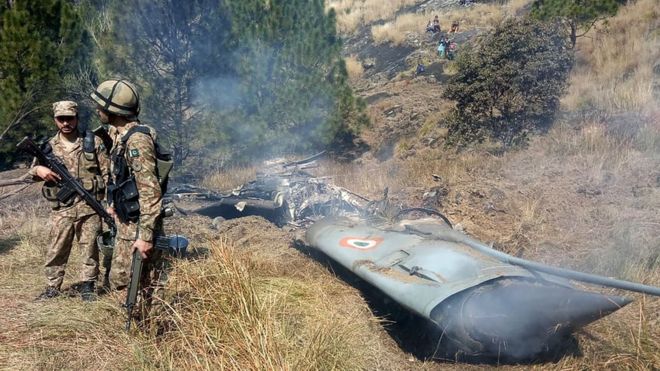
Indian Prime Minister  Modi’s actions, which have led to the shadow of war looming over the sub-continent were to achieve victory in the election in April for the simple reason that these actions have achieved nothing else. Modi’s lack of evolutionary growth as not just a leader, but as a humanitarian is evident, however, lest the selfish interests of a man looking to deceive his nation are prioritised above the survival of a billion and a half innocent Pakistanis and Indians, most without enough food to eat, it will lay testament to not just our lack of evolutionary growth as a people, but our fall into something beneath the human kind.  Keep reading ..... [........]

Our Captured, Wounded Hearts: Arundhati Roy On Balakot, Kashmir And India ....[...... ]

~~~~~~~~~~

DELHI IN DISNEYLAND

By Fahd Hussain
In a span of one week, India dropped its payload, its military reputation and its moral standing. What a week for Narendra Modi and his plans to dominate the escalatory and electoral ladders. Now both are in disarray.
Many lessons should be drawn from the events unfolding after the Pulwama attack. Since we are still in the thick of the crisis — with the Line of Control (LoC) red hot — key takeaways of the post-Pulwama situation may best wait. But some things cannot, and should not, wait for the guns to fall silent.
Remember the picture of the captured Indian pilot with a bloody nose? While the pilot’s nose may have already healed, India’s nose will not heal so soon. Here’s why:
India has built around itself an aura of a global power whose time has come. For at least the last two decades it has been inflating itself as military-economic-cultural juggernaut that is gaining in size and strength with each passing year. While it may be true that India has made significant strides in all three areas, Indians made one unwitting mistake — they took their eye off the in-swinging ball. In the exuberance of sudden global attention, the Indian storytellers of the political-media combine veered from fact into fiction. Most did not detect this gradual transformation of the India story from what it was to what they wished it were. There were voters and viewers to be won and nothing wins them over more effectively than a well-told story.
And so over the years, India began to genuinely believe that it was the Elevated One, the Designated One, perhaps even the Chosen One. The future, Indians said with earnest glee, was India’s. And the future was already here. In this future-draped present, many Indians believed, Pakistan was a fly that could be swatted when it buzzed too loudly in India’s ear.
Delusions of grandeur were an organic by-product of this manufactured belief. The world began to see Indians weaving these delusionary strands into their social DNA and emitting them through their thoughts, attitudes and demeanour. Many Indians sprayed an air of misplaced superiority on themselves like cheap perfume and strutted around like peacocks. But superiority against whom? China? America? Russia? Even delusions have limits. Pakistan therefore became the natural comparison. By trashing Pakistan, bad-mouthing Pakistan, threatening Pakistan, many Indians perhaps subconsciously tried to validate their deeply-ingrained delusions.
So we saw India’s politicians and media people obsessing about Pakistan. To them Pakistan was a carpet under which they could hide their own dirt, and perhaps their insecurities too. This peculiar obsession with Pakistan birthed a weird cycle of national hysteria in India: political discourse fuelled media’s poisonous rhetoric which in turn nourished popular Bollywood trash which then fed back into political bashing that provided sustenance to media’s prime-time obsession with Pakistan….And the cycle went on and on increasing in velocity and intensity with each passing day.
India thought it was chasing Pakistan; in reality it was chasing its tail.
As these delusions ballooned, so did their manifestations through words and actions. Behind the hissing of Indian anchors and the sneering of Indian columnists you could detect that hostility to Pakistan had changed to an air of superiority that had transformed into thinly-disguised arrogance articulated via sweet seething contempt. This contempt was borne with something deeper than cricketing rivalry or Kashmir or even the original wound they suffered in 1947 — no, this was visceral stuff.
Not surprising then that every time in recent years when a conflagration happened, Indian politicians and commentators would threaten to “teach Pakistan a lesson”. Such a threat insinuated that India could, if it wanted to, sort Pakistan out, but wasn’t doing so because it could “tolerate” Pakistan. The assumption was that it was India’s restraint — not its inability — that was holding it back from swatting Pakistan like a fly. Delusions had taken on a life of their own, and were paying rich dividends both in terms of votes and ratings.
All in India would have lived happily ever after in this bubble had they not decided to act upon it. Bubbles burst easily, you know.
The cyclone of Politician-Media-Bollywood fuelled anti-Pakistan delusional hysteria peaked the day Indian aircraft violated our air space and dropped their payload on a Balakot hillside. The next 24 hours saw India experiencing genuine nirvana — the kind in which you go into a hypnotic paradise and wonder why the world is so beautiful, colourful and serene. Indians laughed and cried and hugged themselves while jumping up and down. They loved life and every single payload it had to offer. They were superior. They were powerful. It was all true. What Modi said, what media said, it was all true, true, true…
And then, bam!
High in the air above the LoC on February 28, the bubble of India’s huge delusion burst in a gigantic ball of fire and crashed on the ground along with the debris of a billion people’s aspiration of grandeur. The bloody nose was not Abhinandan’s alone.
And suddenly, just like that, the hypnosis of a nation began to recede. People rubbed their eyes in Delhi, Mumbai, Haryana, Pune, Hyderabad and Bangalore and peered hard into the real world outside the bubble. And there they saw the ugly reality: There was no seminary in Balakot, there was no target hit, there were no 300 casualties, there was no Pakistani F16 downed, there was no revenge taken and there was no punishment meted. They rubbed their eyes more and saw the contours of the harsh truth staring back at them with cold, empty eyes: India did not have military superiority to ‘sort out’ Pakistan, India did not have operational strength to violate Pakistani territory without paying a price, India did not have the ‘story’ to justify victory of any sort and India did not have the regional or global muscle that it could flex at the expense of Pakistan.
The felling of two Indian planes and the capture of one pilot was not enough damage to overturn decades of delusions; but it was enough to puncture the bubble. Modi tried to kill Pakistan’s deterrence, he ended up killing India’s dream.
It’s a different world out there beyond the bubble; a world where the bleeding wound of Kashmir is more visible than ever before; where the policy of trying to ‘punish’ Pakistan is under greater criticism; where loud- mouthed anchor and their studio clowns in Noida are eating crow — and their pride — in dry mouthfuls; where media intellectuals out to de-clutter things are finding it impossible to de-clutter the emotional baggage of their own professional dishonesty, where Indian generals and air marshals are stammering like bumbling idiots; where the lies peddled repeatedly over the years by governments and the media are coming undone in the hills above Balakot and where millions of sane Indians may soon be asking themselves: all those dreams and delusions of grandeur — were they all lies, lies, lies…?
And you thought India had just lost two planes?

Bernard Lewis, Zionists and Western Plans to Carve up Middle East and Pakistan. How to Counter these Anti Muslim Plans! اسلامی دنیا اورپاکستان کی تباہی کا منصوبہ – برنارڈ لوئس پلان


While turmoil and anarchy in the Middle East can be attributed the disunity among Arabs, the possibility of execution of well known Zionist plans supported by USA and West, to divide the Middle East in fragmented state lets cannot be ruled out. The “Bernard Lewis Plan” named after its architect Bernard Lewis, a specialist in ‘oriental studies’, the ‘history of Islam’ and the ‘interaction between Islam and the West’ is well known. Yet another  Zionist Plan for the establishment of greater Israel by dividing Middle East known as “Oded Yinon Plan”, also exists. Christian-Zionist lobby has heavy influence in politics and US government. Policies of Trump and earlier rulers clearly indicate US support for Zionism in Israel. The “Bernard Lewis Plan”, “Oded Yinon Plan” and “Christian-Zionism”, all “Three” are fully integrated to achieve their heinous designs against Muslims. ... Keep reading ..... [......]
Bernard Lewis, Zionists and Western Plans to Carve up Middle East and Pakistan. How to Counter these Anti Muslim Plans! اسلامی دنیا اورپاکستان کی تباہی کا منصوبہ – برنارڈ لوئس پلان https://bit.ly/BernardPlan

War of Words Between India and Pakistan over Kashmir


After hearing the reference to UN resolutions vis-a-vis Kashmir and demilitarization in Prime Minister Nawaz Sharif’s speech in the United Nations General Assembly earlier today, I thought I’d write a little something about the resolution adopted by the United Nations Commission for India and Pakistan (UNCIP), which underscores that demilitarization is a prerequisite for Pakistan as well before an impartial plebiscite could even be considered.

In January 1948 India referred the Kashmir dispute to the United Nations (Rahman 1996: 15–19). Prime Minister Nehru took the dispute with Pakistan over Kashmir beyond local and national boundaries by bringing it before the UN Security Council, and seeking a ratification of India’s “legal” claims over Kashmir. The UN reinforced Nehru’s pledge of holding a plebiscite in Kashmir, and in 1948 the Security Council established the United Nations Commission for India and Pakistan (UNCIP) to play the role of mediator in the Kashmir issue. The UNCIP adopted a resolution urging the government of Pakistan to cease the infiltration of tribal mercenaries and raiders into J & K. It also urged the government of India to demilitarize the state by “withdrawing their own forces from Jammu and Kashmir and reducing them progressively to the minimum strength required for the support of civil power in the maintenance of law and order.” The resolution proclaimed that once these conditions were fulfilled, the government of India would be obligated to hold a plebiscite in the state in order to either ratify or veto the accession of J & K to India (Hagerty 2005: 19). Sir Zafarulla Khan, Pakistan’s Minister of Foreign Affairs, while discussing the volatile Kashmir issue at the UN on 16 January 1948, said that the maharaja’s government had attempted to brutally quell the spirit of revolution in Kashmir: “They were mowed down by the bullets of the State Dogra troops in their uprising but refused to turn back and received those bullets on their bared breasts” (United Nations Security Council: 65).

This political stalemate led to the resumption of bitter acrimony in 1948. Sheikh Mohammad Abdullah voiced his disillusionment with the wishy-washy role of the UN Security Council. He expressly declared on 22 April 1948 that the Security Council resolution was “yet another feature of power politics on which the Security Council has embarked ever since its inception.” The Sheikh condemned the machinations of imperialist powers like the US and the UK which “saw Kashmir only as the neighbour of Russia and therefore an essential base in the encirclement of Russia for future aggression” (Krishen 1951: 19–20). A provisional cessation of hostilities, however, occurred in January 1949, with the establishment of a political and military truce.

The ceasefire line left the Indians with the bulk of Jammu and Kashmir’s territory (139,000 of 223,000 square kilometres, approximately 63 per cent) and population. The Indians had gained the prize piece of real estate, the Kashmir Valley, and they also controlled most of the Jammu and Ladakh regions. These areas became Indian Jammu and Kashmir (IJK). The Pakistanis were left with a long strip of land running on a north–south axis in western J & K, mostly Jammu districts bordering Pakistani Punjab and the NWFP . . . a slice of Ladakh (Skardu), and the remote mountain zones of Gilgit and Baltistan (the Northern Areas or NA). (Bose 2003: 41)

The de facto border carved in 1949 worked to India’s territorial and political advantage.

The president of the UN Security Council, General A.G.L. McNaughton of Canada, endeavored to outline proposals to resolve the dispute. He proposed a program of gradual demilitarization and withdrawal of regular Indian and Pakistani forces, which were not required for the purposes of maintaining law and order from the Indian side of the cease-fire line. He also proposed disbandment of the militia of J & K, as well as of forces in Pakistani-administered “Azad” Kashmir. McNaughton recommended continuing the administration of the Northern Areas by the local authorities, subject to UN supervision. He recommended the appointment of a UN representative by the secretary general of the UN, who would supervise the process of demilitarization and procure conditions necessary to holding a fair and free plebiscite (Das 1950). Although McNaughton’s proposals were lauded by most members of the Security Council, India stipulated that Pakistani forces must unconditionally withdraw from the state, and that disbandment of Pakistani-administered Kashmir troops must be accomplished before an impartial plebiscite could be held (Rahman 1996: 90–91). In the interests of expediency, the UNCIP appointed a single mediator, Sir Owen Dixon, the United Nations representative for India and Pakistan, Australian jurist and war-time ambassador to the US, to efficiently resolve the conflict.

A meeting of Sheikh Mohammad Abdullah’s National Conference was convened on 18 April 1950, in order to pass a resolution expressly warning the United Nations to take cognizance of Pakistan’s role as the aggressor (Korbel 2002: 170). The Communist writer Rajbans Krishen wrote an entire book to establish that the UN, its Commission and its representative, Sir Owen Dixon, were instruments of the US and the UK to annihilate the progressive movement pioneered by Sheikh Mohammad Abdullah in order to create in Kashmir, with the aid of Indian and Pakistani capitalists, a military base for an attack on the Soviet Union (ibid.: 257). The Communist leader in Kashmir, G.M. Sadiq, underscored the skepticism prevalent in Kashmir at the time:

. . . the time has come for India to withdraw the Kashmir question from the Security Council . . . [as] the Kashmiris realized that the talk of fair plebiscite was a mere smokescreen behind which the Anglo-American powers were planning to enslave the Kashmiris. Nothing will suit them better than the façade of trusteeship in Kashmir behind which they can build war bases against our neighbours [sic]. (Delhi Express, 1 January 1952)

Even as the Sheikh was aware of the infeasibility of withdrawing the Kashmir issue from the UN, the Sheikh-led NC reiterated its commitment to securing the right of self-determination for the people of Kashmir. It was suspicious of the UN, which was subservient to the hegemony of the US and the UK and flinched when it came to holding a plebiscite in Kashmir (Korbel 2002: 259). Sheikh declared that if a plebiscite was held in Kashmir and the people of Kashmir did not validate the accession to India that would not imply that, “as a matter of course Kashmir becomes part of Pakistan. . . . It would regain the status which it enjoyed immediately preceding the accession [i.e. independence]” (The Hindu, 26 March 1952). In 1949, the Sheikh candidly told Michael Davidson, correspondent of the London Observer, that, “Accession to either side cannot bring peace. We want to live in friendship with both the Dominions” (quoted in Saxena 1975: 33).

The insistence on rejecting the trajectory charted out for them by the power structures of India, Pakistan and the west, and the urge to proclaim themselves a nation that is capable of exercising the right of self-determination has haunted the psyche of the Kashmiri people for decades. The distrust that pervaded the Kashmir political scene was outlined by the Communist paper People’s Age, which assessed the report of the United Nations Commission to the Security Council as an instrument of the political intrigues and machinations of imperialist powers against the engendering of democracy in J & K. It was critical of the complicity of Pakistan with these powers to destroy the beginnings of a democratic mass movement. It evaluated the attempt of the US and the UK to preside over a purportedly “free and fair” plebiscite that would be held “under the direction of the military and political agents of American imperialism, masked as the UNO Commission officers,” as a strategy on their part to create and secure war bases on the subcontinent against the Soviet Union and China (Krishen 1951: 38).

As a placatory measure, in 1949 the UNCIP declared that “the Secretary-General of the United Nations will, in agreement with the Commission, nominate a Plebiscite Administrator who shall be a person of high international standing” (Dasgupta 1968: 402–03). Needless to say, the plebiscite was never held. The inability of the Indian government to hold a plebiscite is regarded by the Pakistani government as an act of political sabotage. The Indian government has been rationalizing its decision by placing the blame squarely on Pakistan for not demilitarizing the areas of J & K under its control, which was the primary condition specified by the United Nations for holding the plebiscite. Josef Korbel, the Czech UN representative in Kashmir, observes that ten weeks after the Security Council had passed an injunction calling on both India and Pakistan to demilitarize the Kashmir region within five months, Sir Owen Dixon found that not an iota of work had been done in that regard. Although both parties had agreed to hold a plebiscite in the state, they had failed to take any of the preliminary measures required for a free and fair referendum. Sir Owen Dixon, therefore, decided to take matters into his own hands and asked for the unconditional withdrawal of Pakistani troops. This was followed by a request to both countries to enable the demilitarization of Kashmir. The then Prime Minister of Pakistan, Liaquat Ali Khan, agreed to initiate the process by calling for the withdrawal of his troops.

But this request, which would have enabled the maintenance of law and order, was denied by India (Korbel 2002: 171). The rationale that India provided for its denial was the necessity to defend Kashmir and maintain a semblance of order. India vehemently opposed any proposal that would place Pakistan on the same platform as India, and which would not take into account the incursion of Kashmir territory by Pakistani militia and tribesmen. In order to neutralize the situation, Sir Owen Dixon suggested that while the plebiscite was being organized and held, the entire state should be governed by a coalition government, or by a neutral administration comprising non-partisan groups, or by an executive formed of United Nations representatives. But his proposal did not meet with the approval he expected. He noted, in 1950, that the Kashmir issue was so tumultuous because Kashmir was not a holistic geographic, economic or demographic entity, but, on the contrary, an aggregate of diverse territories brought under the rule of one maharaja. In a further attempt to resolve the conflict, Sir Owen Dixon propounded the trifurcation of the state along communal or regional lines, or facilitating the secession of parts of the Jhelum Valley to Pakistan (Ganguly 1997: 3–4, 43–57; Rahman 1996: 4).

Despite the bombastic statements and blustering of the governments of both India and Pakistan, however, the Indian government has all along perceived the inclusion of Pakistani-administered Jammu and Kashmir and the NA into India as unfeasible. Likewise, the government of Pakistan has all along either implicitly or explicitly acknowledged the impracticality of including the predominantly Buddhist Ladakh and predominantly Hindu Jammu as part of Pakistan. The coveted area that continues to generate irreconcilable differences between the two governments is the Valley of Kashmir. Dixon lamented:

None of these suggestions commended themselves to the Prime Minister of India. In the end, I became convinced that India’s agreement would never be obtained to demilitarization in any such form, or to provisions governing the period of the plebiscite of any such character, as would in my opinion permit the plebiscite being conducted in conditions sufficiently guarding against intimidation and other forms of influence and abuse by which the freedom and fairness of the plebiscite might be imperiled. (The Statesman, 15 September 1950)

Sir Owen Dixon nonetheless remained determined to formulate a viable solution to the Kashmir issue and suggested that a plebiscite be held only in the Kashmir Valley subsequent to its demilitarization, which would be conducted by an administrative body of UN officials. This proposal was rejected by Pakistan, which, however, reluctantly agreed to Sir Dixon’s further suggestion that the prime ministers of the two countries meet with him to discuss the viability of various solutions to the Kashmir dispute. But India decried this suggestion. A defeated man, Sir Dixon finally left the Indian subcontinent on 23 August 1950 (Korbel 2002: 174). There seemed to be an inexplicable reluctance on both sides, India and Pakistan, to solve the Kashmir dispute diplomatically and amicably. Sir Dixon’s concluding recommendation was a bilateral resolution of the dispute with India and Pakistan as the responsible parties, without taking into account the ability of the Kashmiri people to determine their own political future.

After Dixon’s inability to implement conflict mitigation proposals, Frank Graham was appointed as mediator in 1951. Graham proposed the following: a reaffirmation of the ceasefire line; a mutual agreement that India and Pakistan would avoid making incendiary statements and that would reassert that Kashmir’s future would be decided by a plebiscite; steady attempts at demilitarization. But he was unable to dispel the doubts raised by the governments of India and Pakistan on securing the approval of both governments on a strategy for withdrawal of forces from the state, and agreement of both governments on a plebiscite administrator (ibid: 239–40). Given the unviability of its proposals, the UN soon bowed out of the political quagmire, leaving an unhealed wound on the body-politic of the Indian subcontinent: the Security Council resolutions affirming that the future of the state should be decided by its denizens.

War of Words Between India and Pakistan at the United Nations by NYLA ALI KHAN.
Source:  counterpunch.org

Related:
~ ~ ~ ~ ~ ~ ~ ~ ~ ~  ~ ~  ~
Humanity, Religion, Culture, Science, Peace
A Project of Peace Forum Network: Overall 3 Million visits/hits