Featured Post

FrontPage صفحہ اول

Salaam Pakistan  is one of projects of  "SalaamOne Network" , to provide information and intellectual resource with a view to...

Modernity and national narratives


The idea of what is meant by Pakistan as a modern nation state and how it is represented in the national narrative were discussed at the LLF in two different sessions.

The first one, aptly titled ‘Pakistan, a Modern Country?’ had journalist Owen Bennett-Jones as the moderator and the panel consisted of historians Ayesha Jalal and Francis Robinson and journalist and writer Tariq Ali. Though it is difficult to share a stage with an orator as intimidating as Ali, Jalal’s impressive knowledge and historical approach were great additions to Ali’s sociopolitical analyses.

Bennett-Jones opened the discussion by highlighting the topic’s varied interpretations. Robinson talked in detail about what the modern state as an idea means in political theory. According to him, to be called modern, a state must exercise three powers: coercive power within its boundaries, which means it should be able to reach each individual and remove any intervening party between the state and individual, in addition to defending its boundaries; the power to protect its minorities; and the power to collect taxes. He said that despite Pakistan’s difficulties with these functions, he has been very impressed with the rise of the middle class over the last 30 years. Population, according to him, is one of the most pressing challenges for Pakistan.

Ali opined that some people consider the possession of nuclear weapons an aspect of modernity, which he does not agree with. The provision of some rudimentary education, welfare and health are the important aspects of a modern state, he said, adding that “the bulk of those who created Pakistan did not want an Islamist republic”. He gave the example of the Khilafat movement — deemed important in the anti-imperialist struggle — which many Muslim leaders were not happy with. “Religion should not be part of the functioning of the state,” he stressed.

Jalal, however, emphasised that religion in some cases has a necessary place in government as democracy comes in many forms. For her, it is neutrality, rather than the absence of religion, that is the defining feature of a modern state. She further explained that many problems are strategic in nature, not religious. Over the years “state has lost that narrative it itself created.” She also dwelled upon Pakistan’s postcolonial legacy which has “modern problems”. It inherited many structural problems, like that of sovereignty, from its colonial rulers. Ali discussed middle-class religious movements which are very modern in nature. However, “such movements are not political movements in a direct sense but largely cultural and attract a lot of people,” he said, adding that “the problem is once these genies are out of the bottle they can never be put back.”

In response to a question concerning how a modern society can survive in a country which isn’t modern, Ali responded that the hope is that Pakistan does survive as being a nuclear power it is hard to imagine otherwise.

When the panellists were asked which politician they would vote for in the next election, Ali was the only one who responded seriously: “I will vote for Imran Khan. If he gets elected — and that’s a huge if — and implements even half of what is being promised.”

The session ‘National Narrative’ also had Bennett-Jones, but this time along with journalists Basharat Peer and Sarah Singh and historian Urvashi Butalia. Khaled Ahmed, who was the moderator, couldn’t arrive on time and 15 minutes after the session was supposed to start Bennett-Jones took matters into his own hands and asked the speakers about their thoughts on the topic. Singh started the discussion by saying that “the topic can be interpreted in two ways: in one sense a nation has many narratives but a narrative can have many nations.” Peer highlighted the exclusive nature of a monolithic idea, such as that of a national narrative, which ignores those parts of a nation that are inconvenient to talk about. Butalia pertinently mused: “It’s strange that there’s a panel on national narratives in Lahore and you have three Indians sitting on it.”

Ahmed then joined the discussion and explained what a national narrative means in theory: a discourse created by the state to create uniformity. Pakistan, according to him, is living under three narratives: the first is external, based on facts; the second is pan-Islamic and opposes the first narrative; and the third sees the world through an Indian prism. However, there could be alternative narratives too, he said. When Bennett-Jones expressed his doubts about Ahmed’s idea of alternative narratives, he said such narratives are possible to create under democracy with freedom of speech. Butalia interjected with the comment that “both India and Pakistan want to present a linear national narrative and history.” Peer also highlighted the pertinent issue of the plight of minorities, saying that “we need to extend our solidarities beyond borders.”

PAKISTAN THROUGH MOVIES

‘The Holy Warrior and the Enemy (1958-2008): Film, Newsmedia, and Music in Frontline Pakistan’ was one of the most intriguing sessions at the LLF. Journalist and film-maker Hasan Zaidi started the talk by explaining the reason behind having a session on cinema in a literary festival. He said that it was important to look at mediums other than books and that cinema is a unique medium — combing the art of seeing, writing and singing — that has never been taken seriously in Pakistan, which is why there hasn’t been any contextualised reading of cinema as a significant genre that reflects our collective memory.

Zaidi was joined by Hameed Haroon of the Dawn Media Group and a Q&A between the two followed along with a presentation of clips from different Pakistani films, jihadi videos and electronic-media programmes. Haroon discussed the theme of the holy warrior in Pakistani cinema in a historical context, saying that the disillusionment of living in a postcolonial society led to the search for a messiah figure in early films. Film creators captured the general discontent in society and most early films in Pakistan talked indirectly about social and political issues. For instance, Khalil Qaiser’s film Shaheed was apparently about oil imperialism as well as about Pakistani society at the time.

There were attempts at promoting the image of a soldier messiah in the reign of Ayub Khan when songs by Noorjehan and Naseem Begum further strengthened the nationalist sentiments. However, the emotions of these singers were genuine and should not be confused with the state’s promotion of a certain ideology, Haroon argued. For the army to be the holy warrior they need an enemy like India. In 1965, Lakhon Main Ek was released, showing a Hindu-Kashmiri girl falling in love with a Muslim-Kashmiri boy.

In Ziaul Haq’s era, religious imagery was strengthened and a clip from the movie The Blood of Hussain was shown to corroborate that point. Zaidi and Haroon also discussed the film International Gorilay, which shows the protagonists (holy warriors) in the heightened religious context of the fatwa against Salman Rushdie.

Next, two films about Daniel Pearl’s murder, The Journalist and the Jihadi (a documentary) and Infinite Justice (a much better film than the Hollywood one starring Angelina Jolie, in Haroon’s opinion) were discussed to analyse the post-9/11 concept of the holy warrior. The transition is complete as the holy warrior has become a ruthless executioner as shown in the first film, whereas he is portrayed as much more nuanced and doubtful, but an executioner nonetheless, in the latter.

The next part of the session focused on the electronic media in the last years of General (retd) Pervez Musharraf’s regime and on two state-supported films, Jamil Dehlavi’s Jinnah and Shoaib Mansoor’s Khuda Kay Liay, which were attempts to salvage the idea of the messiah from the extremist jihadis. In answer to a question from the audience regarding the future of cinema in Pakistan, Haroon said he is quite pessimistic as it seems that jihadi execution footage has replaced film. He also expressed his reservations about the potential of the news media and the improbability of television (TV drama, in particular) replacing film as a genre.

—    Ammara Khan

<<Free-eBooks Click here>>> 

Prices double in Zardari govt’s five years


Providing any relief or taking any measures to control prices of food items, both at provincial and federal levels, remained an issue of least interest during the PPP coalition government which completes its five-year term on March 16.


The government’s five years proved a boon for manufacturing companies and market forces and a bane for consumers as many of them, hit by cash crunch, literally reduced the practice of bulk purchases owing to other burgeoning expenses, like rising utility and transportation charges and education expenses of their children.

Coalition partners, like MQM, ANP and friendly opposition PML-N, hardly took out any rally or protest march against sky-rocketing prices of essential items, petroleum prices and utility bills, leaving consumers at the mercy of market forces and manufacturers of goods.

Even civil society and consumer associations paid a lip-service to sensitive issues relating to food inflation.

The government never bothered to check the profit margin of manufacturers who continued to push up prices, knowing that no authority would take any action.

Traders and commodity investors played havoc with prices on demand and supply situation.

No one can deny the negative impact of rupee’s losing strength against the dollar, high transportation charges on account of hike in diesel, CNG and LPG prices, changes in duties and taxes and demand and supply position of local crop. The government literally gave a free hand to market players and manufacturers who kept on increasing prices in the absence of any check or monitoring.

Even good wheat crop failed to lower flour prices as flour millers kept on pushing up prices owing to rising wheat prices in open market, delay in getting wheat from provincial departments and hike in support price.

The dollar was equal to Rs62 in March 2008 which is now nearly Rs100, thus making an adverse impact on import of finished products and raw material.

When the PPP assumed power, 10kg flour bag, fine atta, atta no 25 and chakki flour were available at Rs150, Rs23, Rs16 and Rs24 per kg as compared to their current rate of Rs420-440, Rs40, Rs40 and Rs44 per kg, respectively. Basin was available at Rs45 per kg and now it is quoted at Rs100-115 per kg.

Five kg Dalda ghee and five litre Dalda cooking oil were sold at Rs720 and Rs780 as compared to their current rate of Rs995 and Rs1,049, respectively.

One kg ghee pouch of Dalda is now quoted at Rs199 as compared to Rs144 in March 2008.

High quality Kernal Basmati Super was selling at Rs90 per kg in March 2008 as against Rs160 per kg now.

Kernal Shaheen variety sells at Rs135 as compared to Rs80 per kg.

Basmati 85 is priced at Rs95 as compared to Rs55 per kg. Irri 6’s current price is Rs50 as compared to Rs35 per kg.

Fresh milk sells at Rs75 per litre as compared to Rs40.

Nido one kg pack carries a retail price of Rs625 as compared to Rs310, while Everyday tea whitener is now available at Rs560 as compared to Rs285.

One litre Tetra Milk is selling at Rs44 as compared to current rate of Rs90.

High quality mutton is now selling at Rs600-620 per kg as compared to Rs300 per kg in 2008 while veal beef meat with bones is available at Rs320-360 per kg as compared to Rs170 per kg.

Veal without bones is priced at Rs420-460 per kg as compared to Rs200. Live poultry bird meat was Rs112 per kg as compared to current rate of Rs170 per kg.

Tapal Danedar tea (200 gram) now sells at Rs125 as compared to Rs63. Lipton Yellow tea pack is available at Rs137 as compared to Rs70.

Either a political tactic or pre-election move, the government reduced petroleum products rates on Saturday to win masses’ support which were increased two days back. However, when government came into power, petrol and diesel were carrying prices of Rs62.81 and Rs44.59 per litre as compared to Rs103.70 and Rs109.21 per litre.

CNG and LPG were selling at Rs37 and Rs53 as compared to current rate of Rs99 and Rs120 per kg, respectively.

Sugar price more than doubled as it is now quoted at Rs55 as compared to 25.

In pulses, high quality masur is available at Rs90-100 per kg as compared to Rs85 per kg in March 2008.

Good quality moong, mash, arhar and gram pulse prices were Rs110-120, Rs95-105, Rs145-160 and Rs100-105 per kg as compared to Rs50, Rs62, Rs82 and Rs48 per kg.

Karachi Wholesalers Grocers Association (KWGA) Chairman Anis Majeed claimed that food prices had surged by at least 40 to 200 per cent in the last five years due to impact of currency devaluation and high petroleum prices.

He said inflation had hit many economies of the world but in Pakistan our economy did not grow due to lack of policies. He said the government raised water, gas and electricity charges and did not focus on making dams, power plants and tapping solar and wind energy resources.

Anis said no serious effort was made on research and development to raise production of various crops.

With no check on essential items prices, manufacturers of other items also utilized the situation.

For example, Mitchell’s jam and jelly packs are now selling at Rs120 as compared to Rs68, while tomato ketch-up of Mitchell’s and National (big bottle) is priced at Rs170 as compared to Rs85.

General Secretary, Karachi Retail Grocers Group (KRGG), Farid Qureishi, said many items being produced by big companies are selling without any price tag and even weight of many products have also been reduced.

The government did not take any action against the producers.

He recalled that tea packers reduced prices after cut in sales tax to five from 16 per cent on imports after two months they raised the prices.

He said rise in gas, power, petroleum prices and dollar appreciation made a direct impact on domestic product prices.

In soaps and detergents, Surf Excel and Ariel one kg pack are now available at Rs240 each as compared to Rs150 in March 2008.

Lux 125 gram soap is priced at Rs55 as compared to Rs24. Safeguard big size toilet soap is tagged at Rs45 as compared to Rs30. One Sufi detergent bar was Rs20 as compared to Rs36 now.
Aamir Shafaat Khan: http://dawn.com/2013/03/03/prices-double-in-govts-five-years/
-------------------------------------------------------------------------------------------------------------------------------
19 Feb 2013 ... Public debt (both rupee and dollar components of debt) hasincreased at an average rate of 21.5 percent per annum in the last five years ...
www.thenews.com.pk/Todays-News-9-160831-No-guilt-or-shame
<<Free-eBooks Click here>>> 

What a country!


By Anjum Niaz

Yes, what a country! A paradise on earth, that’s what Pakistan got — from shining sea to the second highest peak in the world. Before you declare it ‘paradise lost’, tarry a while and think: Only in this country does the heart beat faster when a PIA plane brings you back to your roots. In no other country does it feel like home. In no other country does the desi food taste as delicious as here. In no other country do you get hugs and kisses accompanied by profuse dinner invitations when you chance upon an old acquaintance. People are genuinely happy to welcome you back to where you really belong.

Only in this country does a tooth extraction cost Rs4,000 and an implant Rs75,000. My dentist in the US charges $500 for tooth extraction and $5,000 for an implant.
“Go back and get your teeth fixed. It’s much cheaper there,” Dr Ruvo tells me when I go running to her for help. Dr Shahid Mahmood, the Texas-trained dentist in Islamabad says: “I tell my friends and family in America to take a trip out to Pakistan, get their dental work done, have a vacation and return refreshed in less than half the money they would spend on their teeth treatment in the US.”

Dental issues aside, Islamabad is a happening place. Some friends wanted to eat out on Valentine’s Day. “We went around but were turned away. Every place was booked solid.”

Professionals in all fields, I find are efficient, friendly and willing to help you when you turn up in their offices to get work like car insurance, car registration, refunds for unused PIA tickets, money transfers and a hundred other things that need to be done if you’ve been away from Pakistan long.

But what a country — where traffic lights don’t exist in the capital city. The message: Drive at your own risk; fend for yourself! There are no cops on the streets. It’s free for all. The daredevil motor bikers challenge every nerve in your body as they charge around recklessly packed with women and children at the back. The only cops you see are standing fiddling with their cell phones or chatting leisurely with each other while lined up along VIP routes daily.

What a country where a property tycoon can buy off the sons of VVIPs, load them with pricey gifts and then openly boast about his feats. First to fall from grace is the son of the Chief Justice of Pakistan. The case stands unresolved. Now it’s Bilawal’s turn to have a multi-million dollar mega-home named after him by Riaz.

What a country where the president of the poverty stricken populace brazenly accepts this graft in the name of his son from the most controversial man in Pakistan. With his own millions stashed overseas, Zardari and son are hardly a charity case in need of a roof over their heads courtesy Malik Riaz. Splashed in the media are photographs of the VVIP father and son holding ‘court’ in one of the 50 formal drawing rooms of Bilawal House in Lahore.

What a country where the same man, Malik Riaz builds a sand castle telling all and sundry that it will be the tallest building in Karachi worth $45bn in partnership with the Abu Dhabi Group. The hyper TV channels go into an overdrive putting Burj Khalifa in Dubai to shame. Malik’s tower will soon replace the Burj in height and grandeur, open-jawed Pakistani public is told. Not so fast! Say the Abu Dhabi Group. They publish a quarter page clarification in all our newspapers contradicting Riaz’s tall claims.

Distancing itself from the deal, the Group declares that the whole exercise was nothing more than a ‘Memorandum of Understanding’ between them and Malik Riaz of Bahria Town. Since both the parties failed to reach a “conclusion” the deal stands cancelled!

What a country where the US dollar touches the Rs100 mark. Instead of stalling the rupee decline, the government dispenses with the services of its finance secretary. A week later, the finance minister too departs, leaving the country’s finances in the lurch. A manager of a local bank tells me that as elections near and uncertainty grows, politicians are busy transferring their ill-gotten wealth out of Pakistan.

What a country where the ruling elite are the main black marketers who pocket $6.12bn, paralleling almost half of Pakistan’s foreign exchange reserves. Their ill-gotten money is mainly acquired through drug smuggling, book piracy, gas and oil smuggling, human smuggling, tax evasion and counterfeit money. Havocscope, the world’s leading provider of information about the black market ranks Pakistan close to Afghanistan which is the world’s number one country with $7.3bn in black market. There are laws to catch the scofflaws but the courts, including the Supreme Court are helpless.

What a country where the son of a prime minister along with a federal minister and a federal secretary are accused of importing the deadly drug called ephedrine and health officials divert 25,000 kg ephedrine to the pharmaceutical companies for smuggling abroad. The then Director General Health Dr Rashid Juma, a respected brain surgeon, in his statement as an ‘approver’ alleges that he was threatened by the then health secretary Khushnood Lashari to do as told or else he’d get the sack. Ironically, the minister and the secretary continue in their posts despite the court accusing them of the crime, while the son who is a member National Assembly is out on bail. The case will gradually fizzle out as happens always.

What a country where the constitution is violated by the lawmakers themselves, most of them holding fake degrees and owing huge sums to the State Bank. When the Election Commission writes to 249 legislators giving them a deadline to prove their academic credentials, only 26 of them respond. The rest, 223 member parliaments miss the deadline, proving they sneaked into the parliaments on suspected fake degrees. Heavens don’t fall. There is business as usual. When the State Bank threatens to out the identities of the bank defaulters, pressure from the government and the opposition arrives and the matter goes into a limbo.

What a country where one million ton plastic bags a week are thrown randomly and are left lying forever. Most of them make their way to the chocked gutters or fly around in the wind until they land on trees and bushes. We have a minister and a secretary in charge of environment. They, like the rest of the government wear blinkers and perhaps don’t see the plastic bags suffocating the environment.

Still, what a country where ordinary people are the most resilient, hard working and honest — Pakistan could have been a paradise for all — from the privileged to the underprivileged, had it not been pillaged repeatedly by those in whom God had wrested power.

Paradise lost and regained may yet be the lasting narrative for Pakistan.

 anjumniaz@rocketmail.com
http://dawn.com/2013/03/03/what-a-country/
<<Free-eBooks Click here>>> 

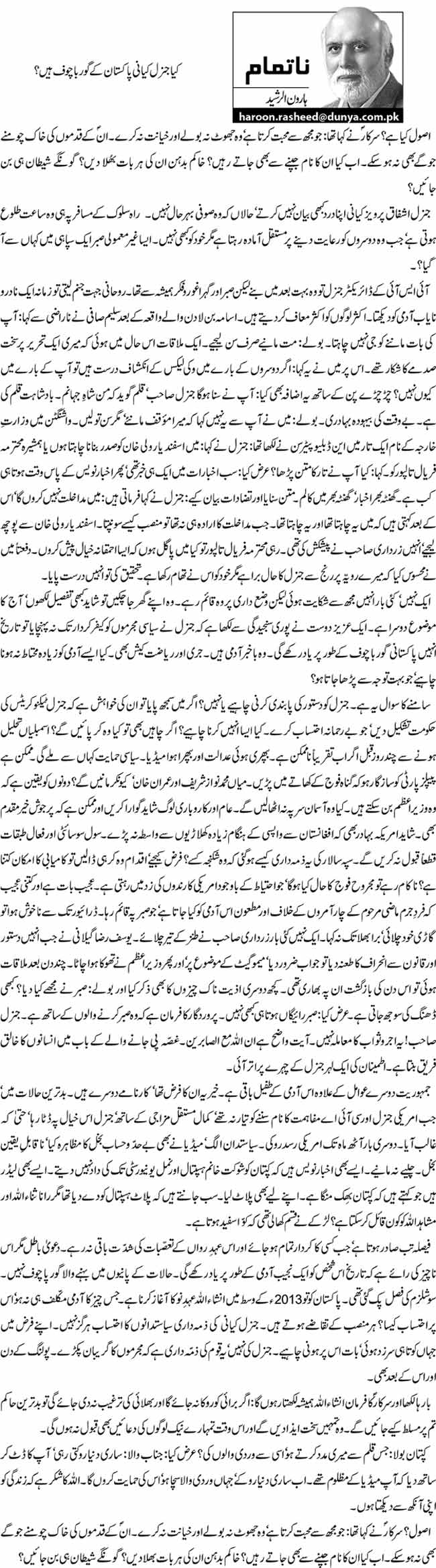
General Gorbachev of Pakistan?

General Kayani spills the beans, blames others, raises doubts: By Shaheen Shehbai

General Kayani has finally spoken his heart out and the information trickling out from the not so off-the-record four-hour briefing is revealing as well as a cause for serious concern and a warning for the civilians and the country.
The bottom line General Kayani gave was that he wants free and fair elections and a peaceful transfer of power and everyone must respect the mandate of the people and for this the army will provide the maximum help, but only that much which is asked for by the civilians.
So in other words what the general said repeatedly was that no one should try to play games with the transparency and fairness of the elections and the results must be accepted but the army will not impose itself in any way and this job has to be done by the civilians themselves.
Yet while confirming that the army has pulled out of these, and almost all other, matters in the civilian domain, General Kayani gave a long list of civilian failures, almost a charge sheet against the politicians and the government and placed the blame of gigantic failures in many critical domains at the civilian doorstep.
Not to intervene is constitutionally and practically a very positive and constructive approach but in reality it has brought the country to the verge of a collapse and General Kayani realises that but does not want to share the blame. 

[Under which clause of constitution he told Aitezaz Ahsan to ask Nawaz Sharif to call off  'long march', judges  being restored?]

Examples of the civilians’ failure that he quoted, in his own soft style and in a non-intrusive way, were many but a cool analysis of his thoughts and ideas reveals he has told the government and politicians they had messed up in a big way and no more of this mess-up can be afforded.
For instance, he says on the key issue of war against terrorism, the army is not to be blamed but the civilians have not formulated a comprehensive anti-terrorism policy and they could not decide what to do. They threw the ball in the court of the army without giving them policy guidelines, the targets to be achieved and the way that was to be done.
Repeatedly, he said that the army had not been consulted or taken on board about the political all parties conferences being held on counter terrorism.
General Kayani, in this context, quoted many examples and reminded the media men of the Swat situation where he said the President was persuaded by him to take a decision. He also took ANP leader Asfandyar Wali to the President and when the decision was taken to talk to Maulana Sufi Mohammed, the talks were held but when he violated the accord, an operation was launched. Then the civilians had to take over the responsibility which, he implied, they did not.

General Kayani specifically mentioned the arrests made in Swat and complained that if the arrested persons are not convicted because of lack of evidence, the army cannot hold them forever. For three-and-a-half years it is holding these people and is either violating laws by doing so or risks more terrorism if they are released.
Likewise, in Balochistan, General Kayani said, an army operation could be launched only if the civilians take that decision and order the army to do so. But once the operation is done and people are arrested, they will again have to be tried and convicted by the police and courts for which the civilians are not prepared and ready.
Similarly, he said the civilians depend too much and remain forever scared of the ISI and army intelligence agencies whereas the tasks should have been done by their own agencies.
All internal matters have to be handled by the civilians as the ISI has to look after external intelligence threats and the army has to secure borders. Where are the civilian agencies? he asked, in so many words, though politely.

General Kayani’s talk was almost a report card of failure of the interior ministry but he said in so many words that for five years the army took all these failures in its stride, and sometimes guided the civilians to reform and take ownership and responsibility yet did not intervene to stop the rot.
In my view, this was a very considered and deliberate policy as General Kayani and his colleagues knew the capacity of the civilians. They knew that these politicians will not be able to handle such colossal issues like the war on terror, the Balochistan mess, the fight against domestic extremism and fanaticism but they left everything to these immature and inexperienced or incompetent politicians so that the army may not be blamed and the onus of the disaster falls on the civilians.
Now he has explained his five years of non-interference by the army, failure of the civilians to cope and the resultant disasters in a four-hour session which can be summed up in one line: “Don’t blame us. Do something if you can.”
The tragedy is that General Kayani knows well that the 10 years of General Musharraf and the total dominance of the army, the persecution of politicians, the disarray in the political system, the physical threats to political leaders, their assassinations and mass murders, all meant that the politicians were not ready, although they had been voted into power because an election was held and that too under the threat of mass rebellion after Benazir Bhutto’s murder.
So there was no way the army could avoid an election but there was no way the civilians could correct everything messy that the generals were leaving behind.
Similar is the issue with the present elections. General Kayani is now saying that elections must be free, fair and transparent but the set-up that has been put in place is controversial, weak and fragile, weakest at the top.
In his four-hour talk he referred to this weakness of the ECP in his own way by recalling the famous meeting between him and Fakhru Bhai in which a briefing was given by the army to the CEC for over two hours but at the end Fakhru Bhai did not recognise General Kayani.
“Yes I am General Kayani” he told the ageing CEC but then also recalled the story of Alif Laila and the joke associated with it when after the whole night someone asked: “Was Zulekha a man or a woman”.
By referring to Fakhru Bhai and speaking about his age and his capacity, General Kayani indirectly expressed doubts that he can handle such a gigantic task of holding the election. He also knows that politicians have nominated the other four members of the ECP and they are political nominees who can, and may, play games for their sponsors.
So when he says that elections must be fair and free, he is again shifting the blame to the civilians while knowing that they do not mean a fair business and they will do the mischief in their own ways. He is not ready to interfere but is only asking them not to try. Yet he has walked out of providing army cover to the polls saying he cannot spare 200,000 troops. Fakhru Bhai has been left high and dry, on his own. 
So if the politicians don’t listen to the army chief, the bottom line is that nothing will happen. Kayani has already, and in the same meeting, announced that he will retire later this year, or just after a few months after the elections. The politicians can even cut that period short by announcing his replacement three months ahead of the date. So the politicians will play around and the general will go home, leaving the mess for the people to face.
His clearest warning was on the economy and again he blamed the civilians entirely for the failure. He recounted so many instances and asked do you blame the army for this, for that and for everything. He, however, allowed the corrupt civilians to do the damage before his own eyes.
The media lot sitting in front of him, it looks, did not disagree with him on this count. But a pile of dirt, mixed with filth and stink left behind by the army after years of misrule cannot be cleared so easily, when the army pulls itself into a corner and does not stop even the most glaring and blatant violations of the laws and Constitution.
What General Kayani could have done, and has not done, was to strengthen and reassure the institutions which can check the incompetent civilians to place strong checks and corrections at every stage, so that things would not have come so near to collapse. When General Kayani retires, as he would in a few months later this year, he would be judged as another leader of the Gorbachev kind. Will he like to be called General Gorbachev?
http://images.thenews.com.pk/28-02-2013/ethenews/t-21262.htm

Comments:
An owner returns to find his house burnt to ashes, the guard tells that it was his duty to protect the house from outsiders, thieves not from fire within. Only a fool shall expect General Kayani to take over, but he could do much more within bounds of constitution. The democratic process must continue. However loot and plundering of national wealth and economy should not go unchecked. Judiciary took bold decisions which were not implemented. Is army like other institutions not bound by constitution to assist Supreme Court? which is the final authority to interpret the constitution? Only a  positive response to suprem court could have deterred the plunderers.....
~~~~~~~~~~~~~~~~~~~~~~~~~~~~~~~~~
No Comments

A day after he granted a three-year extension to the military chief, Prime Minister Yousaf Raza Gilani hailed the move as a ‘guarantee’ for the stability of a democratic system. Speaking to media, Gilani said the extension of COAS General Ashfaq Pervez Kayani’s tenure had put all stakeholders in the power game – the president, the prime minister, the chief justice and the military chief – in a secure position till 2013. (The Express Tribune: July 24, 2010, http://tribune.com.pk/story/30619/kayanis-extension-to-guarantee-democracy-pm/)]
--------------------------------------------------------------------------------------------------------------------------
19 Feb 2013 ... Public debt (both rupee and dollar components of debt) hasincreased at an average rate of 21.5 percent per annum in the last five years ...


Blood of Martyrs of Pak Army is Priceless


http://dunya.com.pk/news/authors/detail_image/2077_40483929.jpg
~~~~~~~~~~~~~~~~~~~~~~~~
Zero Point by Javed Chaudhary
http://www.express.com.pk/epaper/PoPupwindow.aspx?newsID=1101768057&Issue=NP_LHE&Date=20130226
http://dunya.com.pk/news/authors/detail_image/2126_22930578.jpg

Malik Riaz-the real power broker


Politically Incorrect 
by Amir Mateen

Malik Riaz may just be a new phenomenon in Pakistan. No private individual may ever have exercised as much leverage over the state as he does. Is it because the state institutions have become so weak that they can be manipulated easily or is he a very smart man. Either way, this Realtor-in-Chief has got his tentacles all over.

He has control right from the office of the President down to the SHO at Islamabad’s Kohsar Police Station. He can influence khakis from the level of Generals to an MES clerk, the lucrative post from where he took his start to stardom. The media is under control as Bahria Town is one of the biggest advertisement-throwers. Most owners take favours worth their value, while the journalists, particularly a whole generation of easily purchasable new TV anchors are sometimes available even for crumbs. This makes a perfect setting for the reincarnation of Mario Puzo’s Godfather, Malik Riaz, to take the lead role.

The hapless people who get robbed of their land in hundreds of cases have no place to go. The only forum available to them, the Supreme Court of Pakistan, has now been cowed down, thanks to the shenanigans of Arsalan Chaudhary. One must give credit that Malik had the chutzpah to attack the superior courts and then get away with it. Now, he sees no obstructions in converting huge swathes of cheap land, mostly acquired through dubious means, into golden retreats, safari villas and golf clubs. His posh houses are valued at as high as Rs 220 million. Of course, he spares lots of patches for the lower and middle classes to keep up the ‘Sultana Daku’ image that he loves so much. But this largely benefits a small elite club that will continue to grow richer and richer. On his back are the chosen members of that exclusive Club - the most prominent being the President of the Islamic republic.

It’s common knowledge that Malik Riaz is the most important person at the Presidency. The President used his constitutional power to pardon Malik Riaz’s personal guard. The guard was sentenced to life imprisonment after he confessed about killing a person in a shoot-out in an Islamabad market. Who cares that the Presidential discretion is supposed to be used in very special circumstances. This encourages Malik Riaz to brag that he could walk into the President’s bedroom any time. Such bravado keeps the subordinates in line. In most cases he does not need to bother the President. The ministers or anyone who matters —everybody knows how important he is for the President. President Zardari’s sister, Faryal Talpur or somebody from his family is seen photographed at almost every important function organized by Malik Riaz.

Bureaucrats remain as obliging as Alladin’sGenie, especially if they want to live a ‘respectable’ life in the Capital. But he is more interested in postings and officials that handle things related to real estate —actually land-grabbing. Revenue and Administration officials are crucial but the most important is police. It is widely known in Islamabad that nobody gets posted on crucial positions without Malik’s approval.

Hundreds of people have recorded statements before various courts complaining about the police torturing and harassing them “at the behest of Malik Riaz.” In a prominent case, two citizens, Raja Qayyum and Habibullah, complained before the Supreme Court that they were beaten and tortured by SHO Idrees Rathore and DSP Malik Mumtaz on the orders of Malik Riaz. They were allegedly kept locked-up for three months, forcing them to sell their properties to Bahria Town.

Sihala and Bhara Kahu is a Malik terrain and, says a published report, no police officer could be posted there without the approval of Malik Riaz. The report quotes an incident where a Sihala SHO, Haq Nawaz got changed just because he did not give “due protocol” to a person sent by Malik Riaz.

Islamabad’s top cop is known to be a henchman of Malik Riaz. Rumour has it that he was instrumental in getting Malik’s son escape to Dubai when the courts ordered his arrest on the charges of murder. He risked Cntempt of Court many times by dilly-dallying on Malik’s arrest in land-grabbing cases. He twisted facts to evade the registration of FIR against Malik recently.

Malik controls Islamabad’s Police that recently risked fighting a war with their uniformed colleagues when a Rawalpindi court ordered Malik’s arrest. The property Tsar travelled with fleets of Islamabad's heavily armed police commandoes with orders to shoot Rawalpindi police if they tried to arrest Malik. The police forces of the twin cities, playing a cat-and-mouse game, came close to mutual bloodshed many times because of him. At one stage, Malik had the muscle to have Rangers posted at his house. So who runs this country, one may ask.   

In his business, Malik needs official patronage. He was even more boundless during Musharraf’s time. The Chaudharies in Punjab loved to oblige and top civilian lackey, Tariq Aziz and his khaki counterpart, Lt. General (Retd) Hamid Javed delivered the rest of the country— of course on the basis of mutual reciprocity. The beauty of his model is that he gets all favours without spending much. In most cases he obliges them in kind by giving them plots that, interestingly, he acquires with their help. Smart, isn’t it?

The PML-N was opposed to Malik initially but then Shahbaz Sharif got his help in Ashiana Scheme. The extent of Malik's affection for Shahbaz Sharif’s son, Salman got disclosed in an off-camera shoot that somehow got leaked. Remember the ‘scrooing’ episode.

Malik Riaz is a fictional character. In real life the closest example one can think of is former Italian President Silvio Berlusconi. He bought media through his business empire and then used it for his political and business ends. Malik commands as much political control without coming into power directly. So far, that is. But we hear that he has invested huge investments on dozens of potential candidates. And this may be the reason for his recent friction with the Sharif Brother, besides the 25 acre villa that he allegedly built for the Man on the Hill. Who knows he might just take over this country at some stage. Who would not want that with half of the Parliament in his pocket? Imagine Malik Riaz as the PM.


Part II - Will the real Malik Riaz please stand up?

Politically Incorrect

Amir Mateen

Malik Riaz of Bahria Town may be the best prism through which one can understand today’s Pakistan. He personifies the potential that this ‘land of opportunities’ offers, provided you know how to go about it. Palm-greasing, he says, is an essential skill here and that he knows how to attach ‘wheels’ to his work files — a metaphor used for bribery. “Believe me, nothing moves in this country without wheels and my files, I tell you, never stop,” he said boldly in a TV interview, an impish smile on his face. That tells something about the man and the country where he, like it or not, happens to be the most powerful person.
His is a rags-to-riches story that should beat the Carnegies and Rockefellers hands down. The ‘robber barons,’ as the American Moguls were labeled a century ago, got their share of flak. But the biggest realtor baron of this country remains unscathed because he has got the media literally in his pocket. 
Not much is known about one of the richest man in Pakistan except for the bits that he has told about himself. Even Wikipedia says that the details are sketchy on how a small-time labourer climbed up the ladder to become the 10th richest man of Pakistan with assets worth $800 million. He may actually be worth much more if we take into account his ‘file-wheeling’ skills.
The information about him trickles down through carefully selected journalists who throw out carefully orchestrated images of his personality. A self-made man, he passed his secondary school exam by marginal numbers. Equally marginal were his skills as he could not even drive a car. He started off from petty chores, the first being a house whitewash. We are told that he walked for 10 kilometers just to save Rs 50. He had to sell household items, tears in his eyes, to get his daughter medical treatment. 
He is as somebody living next door with whom ordinary people could identify; somebody they could trust with their savings. He almost comes across as Amitabh Bachan, as in Bollywood movie Tirshol, though of course minus the superstar’s beauty, particularly his hair. Suddenly, the hero morphs into a dazzling rich person that the lay people aspire to be. A halo of glitz and glamour circles around his head. Malik Riaz travels in his private jet, lives in seven-star mansions, parks a Bentley in his porch and drives with a fleet of SUVs with a battalion of armed private commandoes that should match the prime minister’s protocol.
Malik Riaz is undoubtedly the most powerful person in Pakistan. He rubs shoulders with the high and mighty that seem to be at his beck and call. He calls former prime minister Yousaf Raza Gillani’s son, MNA Abdul Qadir Gilani, as Bunny, Punjab Chief Minister Shahbaz Sharif’s son, Salman, who takes care of the family business, as Sill. I suspect, in the same pattern, he calls President Asif Zardari and Benazir Bhutto’s son, Bilawal, as Billu. His favourite pass time, we are told, is to order senior functionaries on transfer and postings using some real rough language. This happens on a speaker phone while the worthy guests get amused and awed by his audacity. The treatment was recently meted out to another Malik with an ‘R’ who, outraged at one stage, suspended the officers who had gone to Riaz for a prized posting. The matter got resolved by the Man on the Hill later.
On a typical day, he starts his day with a working breakfast with rich Arab Sheikhs; lunch at the Presidency — with aalu shora he says; evening tea with the Punjab Chief Minister; dinner with top generals and late coffee with the biggest industrialists of this country. But he does not sleep before giving ‘tweets’ to his favourite journalists on how and what to say in the media. If he does not run Pakistan, who does?
Malik remains the biggest paradox. He has got more faces than that Hindu mythological figure from Lanka. Is he the saviour who gives jobs to 20,000 people who in turn cater to a work force of 17000 ancillary industries? Bahria Town brochure boasts that 100,000 households are dependent on them. He goes on to claim, almost in the same hyperbole that he used in the $ 45 billion fiasco, that Bahria Town workers might stretch from Lahore to Rawalpindi if  they are lined up with their arms stretched wide open.
But the questions remain: Is he the great visionary who changed the housing concept in Pakistan, providing the middle and lower classes high quality residential facilities at a much lower cost?
 Is he the messiah who is seen feeding hundreds of people, helping the sick, needy and the handicapped? Bahria Town sponsors many schools, hospitals and charity organizations.
Is he the trouble shooter who somehow emerges as a referee in every political wrestling match. He played a role in Musharraf’s deal with Benazir Bhutto. He was again involved in the Bhurban meeting that led to an agreement between Zardari and Nawaz Sharif. He was instrumental in arranging a patch-up between Asif Zardari and the Chaudharies of Gujrat. Only recently, he popped up out of nowhere to play a role in Tahirul Qadri’s long march.
 Is he the hero of the poor who, as Amitabh Bachan, made it big in the cruel world of the rich. He likes to compare himself with ‘Sultana Daku,’ a local version of Robinhood who looted the rich to distribute among the poor. There are more shades of his personality in real life than the roles that Amitabh may have played in films.
For many, he is worse than Prem Chopra. All that glitz about good work is just a smoke screen that he maintains to hide a sinister villain that comes across in dozens of cases that he attends in various courts and police stations all over the country. The crimes that he is accused of include murder, kidnapping, forgery, fraud, extortion and many other evil things that all Bollywood villains put-together could not have done. These cases run into hundreds, mostly involving land-grabbing where his goons forcibly took away land from poor people to sell houses, some of which cost as high as Rs 220 million—the Sultana Daku in reverse here. Just to explain the extent of accusations against him, he has still got at least three dozen cases before the Supreme Court, despite the disposal of double the number of cases. In one day last year, the Supreme Court issued 44 orders against Bahria Town in various cases.
So how do we judge him. Will the real Malik Riaz please stand up? It is all the more important to understand him as he enjoys the power in this country as nobody else. Whatever the case, he is surely a movie character who got stuck with ordinary mortals.

Part I - $45bn fiasco exposes Malik Riaz

Politically Incorrect 

Amir Mateen 

The biggest-ever media con

Is this funny, sad or simply stupid. The clarification by Abu Dhabi Group about their alleged $45 billion investment in Pakistan may have exposed lots of things — and lots of people. One Malik Riaz of Bahria Town for sure.
He virtually conned the Abu Dhabi Group, Pakistani media and the public. We already knew about his hold on the Pakistani media. And it is not just about that one incident where he was caught red-handed with two TV anchors engineering news. The Bahria advertisements worth billions of rupees have simply blinded media owners who ensure that nothing is published against Bahria Town. News against Malik Riaz comes out only when he is summoned in the courts for the cases of murder, fraud, forgery, assassination attempts, blackmailing, to name some of the ‘virtues’ that he is regularly accused of.
But a more classic example of Pakistani media’s incompetence-actually capitulation-could not be given. Here is why.
The announcement of a whopping $45 billion investment in Pakistan was a dream-come-true story. This too at a time when nobody wants to invest a penny in Pakistan, and half of my foreign friends want to send their mothers-in-law for ‘sight-seeing’ in FATA.
It was simply mind-blowing. The UAE sacrificed its pride for having the world’s tallest building, Burj Khalifa. And because Malik charmed them so well, they let Karachi have the honour. Apart from building the world's tallest building in Karachi, the other attractions included a financial hub, sports city, international city, media city, educational and medical City, miniatures of the world’s seven wonders. It was amply flashed that “these projects would employ more than 2.5 million people and boost more than 55 industries like cement, bricks, iron, steel and glass.”
Malik Riaz came across as the Messiah who had bailed out Pakistan from its financial mess. Abu Dhabi Group Chairman Sheikh Nahyan bin Mubarak al Nahyan was quoted as describing Malik as a “visionary,” adding that this guaranteed that “we will Inshallah be welcoming first residents in next 3-4 years.” As if he was not a ruler but a real estate agent.
Media outlets competed with each other in flashing the news amidst incessant advertisements from Bahria Town. Newspapers were also found outdoing each other. Most newspapers, English and vernacular, presented what was basically a press statement by Bahria Town as “independent news.” Nobody checked whether the Abu Dhabi Group, the UAE government or even the international wire services issued any news about an investment that was worth, no less, than $ 45 billion. Not a single journalist bothered to even check if there was any news of this sort on any website of the UAE companies or whether Sheikh Nahayan had actually said those words. The half-page advertisement on newspapers' front pages, showing Malik shaking hands with the Sheikh seem to have blinded everything. Or perhaps they were told not to test their editorial discretion.
The so-called most credible English newspaper went a step ahead by giving a joint dateline of Karachi and Islamabad instead of Dubai. It added colour to the story by quoting a Karachi magnate, of course on the condition of anonymity, that the construction site would be “Kutta Island,” which is 3 to 4-km off the coast of Karachi. It went a step further than what Malik Riaz had claimed, informing readers that “the Abu Dhabi Group-Malik Riaz would, apart from the above mentioned projects, also launch into building of 125,000 houses on the island.” (sic) 
The reporters also made sure to confirm it from the source of the press release, Malik’s son Ali Riaz, instead of checking from the Abu Dhabi Group or even their local counterparts here in Warid, Wateen or Bank Alfalah.
Imagine an investment of $ 45 billion takes place in a place as Pakistan and the news is not on CNN, BBC, The Wall Street Journal, The New York Times or even Reuters and AFP. Fellows — where was the common sense.
Last time, the UAE committed half the amount for construction on the same Kutta island (known as such because people dump stray dogs there) but the Monarch, Mohammed bin Rashid Al Maktoum himself arrived for such a big announcement. However, not a penny came as the UAE was eyeing for Gwadar Port as compensation.
It is actually funny how the media got duped. And that is exactly how they took it in Dubai. A friend who works for The Gulf News shared that journalists there could not believe it in their morning meeting. Everybody laughed as the entire Pakistani media was conned so easily. The Gulf News did not carry the story as there had been no announcement from anywhere. Internationalist journalists saw this “stupid news” on the web and just ignored it. 
My Dubai friend, knowing Bahria’s leverage on Pakistani media, could understand that the news got carried on the first day. “But how about the five days after that,” he asked, confused. “Why nobody followed-up on the story that was supposed to be the biggest investment in the country’s history.”
It turns out that the Abu Dhabi Group and the UAE government was aghast at the development. But since they have lots of investment here they did not want to embarrass Pakistanis. A small news was leaked through Reuters wherein Sheikh Nahayan, while talking to a reporter in a Dubai exhibition, clarified that the investment might materialize in 15 years. He also dispelled the impression about building the tallest building in Karachi, saying that the business plans were “at a very early stage.” 
No paper except The Spokesman carried the story. Sheikh Nahayan also explained that the MOU was signed in his capacity as the owner of his private company, Dhabi Contracting and not as the chairman of the conglomerate, Abu Dhabi Group. He could not have been more specific when he said that it would materialize in phases, adding, “every phase will be studied by itself... It depends on the situation when we decide to go ahead with the projects."
This was to clarify the wrong impression given here by Bahria Town that it was Abu Dhabi Group and not Dhabi Contracting that signed an MOU that only showed minor interest in business here. Still, nobody took the hint here as advertisements kept coming. Nobody questioned that how could a private company in Pakistan commit a $45 billion investment without the government being in the loop. Imagine the world’s biggest building and residential quarters for millions being constructed without any representative from the provincial and federal governments. In Sheikh Nahayan’s case, the assumption of the UAE government could be forgiven as he is a minister and Chairman of Abu Dhabi Group. 
A whole bandwagon of Urdu columnists and TV anchors was found eulogizing Malik Riaz as the savior of the country. After five days, it just became too much for the UAE rulers and they had to issue the clarification that everybody read in newspapers on Friday.
Obviously, the Dubai rulers knew they were duped into that photo-up and their reputation was being used for petty benefits. It is easy to understand the benefits. This kind of news changed the scenario for Malik Riaz. He was being hounded by the courts in numerous cases, some of them seriously heinous. He was in conflict with LDA over opening new housing schemes in Lahore without permission. He was also in conflict with the army for land dispute with DHA that affects thousands of former army officers and jawans. All of this may have shaken the public confidence in his housing projects. In monetary terms this could mean a loss of billions of rupees for him. Such news about building the tallest building in Karachi is worth a lot though. Even if it had not materialized, the impression of a partnership with the Dubai rulers would have rewarded him billions of rupees in terms of public confidence. Elementary, isn’t it.
But the question remains: Was our media (of which I am a part by the way) stupid, incompetent or simply capitulated before the owners. A little bit of everything I think. I was dared by a colleague on twitter that we shall see some expose` when I get up on Saturday. I hope so but am not sure about it.
More: CAPITALISM’S ACHILLES HEEL: Dirty Money and How to Renew the Free-Market System RAYMOND W. BAKER ; Page 76-85 on Pakistan: Bhuttos & Sharif's
<<Free-eBooks Click here>>> 

When a state is dysfunctional


WHO knows what a failed state is? Such definitions are for the academics and experts. But what one can easily ascertain is a state that is dysfunctional.

For what would you call a state that has neither the power to generate resources and tax those who need to be taxed, nor the system or even the need to ensure that it accounts for what it spends? It can keep piling up a huge deficit without question and have nothing to show for it.

What would you call a state that cannot deliver the very least: the safety of life and limb to its citizens? Where if you particularly happened to be in the smaller provinces the only thing you could get by on is your faith. Yes, God remains the only recourse.

It has to be a dysfunctional state where those who call for their legitimate inalienable rights can be picked up in the dead of night and be found weeks or months later in a ditch with telltale signs of what happens if you take your fundamental rights too seriously; where in one part of the country police officers such as Malik Saad, Sifwat Ghayur and hundreds of nameless others whose sacrifices are as worthy as those named, write a final, valiant chapter in their blood.

At the same time an ‘anti-terror’ police boss in another part of the country cuts deals with sectarian murderers to leave his jurisdiction alone reportedly in exchange for safe passage for operations elsewhere and is rewarded with promotions. The sectarian groups are much stronger as a result.

Take Benazir Bhutto, Salmaan Taseer, Shahbaz Bhatti and more recently Bashir Bilour. All these politicians stood like a rock in defying the terrorists, bigots and intolerant ideologies — until they were cut down by the terrorists.

Have you ever seen a person with greater courage than that Pakhtunkhwa minister Mian Iftikhar whose son was mowed down in a hail of Taliban bullets? Neither his grief nor personal loss forced him to bend his resolve.

These are high-profile figures. Can we look at those they left behind in the eye and assure them that the sacrifices of their loved ones were not in vain? Go ahead if you can but I, for one, will be too ashamed to even contemplate doing any such thing.

Is there a point in trying to remember Asiya Bibi? Well done, we can say to ourselves for at least we recall her name.

Do we recall a single name of the many, many Christians who died when their entire neighbourhood was torched in that Punjab village? Gojra, was it?

Surely, we have expressed such outrage over the mass murder of Shia-Hazaras in recent days that we’d be able to think of the victims in terms other than mere statistics. But we can’t. If it was 200 Shia Hazaras killed last year, a greater number has fallen in the first two months of 2013 alone.

We are not supposed to have photographic memories so how can we name a single Hindu woman converted forcibly to Islam. Of course, if (yes, if) the state was not dysfunctional such incidents would be the exception, not the norm. We’d remember the one or two victims.

Now that the state has stood by, paralysed by fear or expediency, we have let armed zealots show all minorities their place. Christians and Hindus couldn’t be more marginalised. The Ahmadi community has been taught how safe it is for them to bow before their God in their place of worship.

Yes, now it is the turn of the ‘minority’ Muslim sect, the Shias, they consider an ‘arrogant’ lot who openly exercise their religious freedom. This too must end. Bomb their congregations; shoot their community notables and who knows they’ll also be subdued into abandoning their faith.

What next? Oh yes plenty left. There are many whose Islamic rituals and practices differ from ours. And religion must not have room for diversity. We must find and exterminate all who don’t agree with what we believe Islam to be.

Next it’ll be women. Lock them up for they aren’t equal citizens of the country; shameless that we have women working side by side with men in most urban centres. They even go to schools, colleges and universities and aspire for careers! Do they think they live in the 21st century?

Surely, they don’t. We’ll make them see their reality. What else will be our fate when we await an ever-elusive consensus while an existential threat snowballs? You and I can simmer and explode all we want.

The vision and the wisdom of the decision-makers can hardly be expected to deliver in such ‘unimportant’ areas. When the Kerry-Lugar legislation was passed, nobody needed a consensus to oppose the principle of civilian supremacy in matters of the state.

When memogate surfaced whatever its merits, extremely dodgy to the naked eye, neither the politicians nor the defenders of our territorial and ideological frontiers needed a consensus. And the courts to this day believe none is needed. Those were bigger threats to our integrity.

We have lost more of our brave sons, soldiers including officers of both regular and paramilitary forces, over the past five years than perhaps in any war that we have fought. And yet we await a consensus to establish whether the state or armed terrorists will rule over swathes of our territory.

An elected government came into being five years ago. It says its unprecedented achievement is completing its term; its unparalleled legislative record which will provide the glue to hold the federation together. All we can count is our dead. Men, women and children.

Now we are told a huge percentage of new young voters have been added to the electoral rolls. Youth represent a hope for tomorrow. Let’s hope that over the next five years we have to count fewer dead. Anything more will be too ambitious an ask.

The writer is a former editor of Dawn.  abbas.nasir@hotmail.com
http://dawn.com/2013/02/23/when-a-state-is-dysfunctional/
<<Free-eBooks Click here>>> 

The Justice of Injustice Indian style: Judicial murder of Afzal Guru

Contrary to the lies that have been put about by some senior journalists who would have known better, Afzal Guru was not one of `the terrorists who stormed Parliament House on December 13th 2001` nor was he among SITUATIONER those who `opened fire on security personnel, apparently killing three of the six who died.` (That was Chandan Mitra, now a BJP Rajya Sabha MP, in The Pioneer, October 7th 2006). Even the police charge sheet does not accuse him of that. The Supreme Court judgment says the evidence is circumstantial: `As is the case with most conspiracies, there is and could be no direct evidence amounting to criminal conspiracy. Keep reading >>>>

http://dunya.com.pk/news/authors/detail_image/1867_45583246.jpg
<<Free-eBooks Click here>>> 

Tahir Qadri - Latest Interview 8 Feb 2013

.

Tune

Youtube

<<Free-eBooks Click here>>> 

Intellectual blockage

Ideas are an integral part of a society. They enable human beings to tackle the challenges of time and accommodate differences within a social whole. At the social level ideas and their materialisation in the form of institutions and norms help societies understand change and make new social arrangements accordingly. At different points in history, societies face situations where a problem becomes insoluble through the available conceptual assemblage of the prevalent paradigm. In philosophy this problem is called ‘aporia,’ which can be translated in simple English as impasse, obstacle or blockage.

The intellectual landscape in Pakistan has all the telltale signs of intellectual aporia. Today Pakistan is facing an existential threat because of various internal and external factors. Such a situation demands introspection in its society. However, the prevalent ideas of Islamism and secularism have failed to provide an alternative vision. In the war of ideas, the intelligentsia of both secular and religious persuasions stay in their ideological trenches and stick to their ideological guns. Therefore, no dialogue takes place between the two and discussions taking place within the respective schools of thought are monologues.

The failure of our minds to take us out of the current morass is the result of an intellectual blockage in Pakistani society. This blockage creates immense existential tension within the society. The killing of innocent people across the country is just a tip of the iceberg. The malaise within the social body can be diagnosed, and can even be cured, if the blockage in thinking is removed. Despite the gravity of the situation, the secular and religious minds are not prepared to break the boundaries of their dogmatic enclosures because they fear they will become irrelevant if the configuration of ideas is changed.

Ironically, it is the intellectual blockage that provides an opportunity to iconoclasts to break the status quo and paves the way for an alternative society. In his book Time for Revolution, Antonio Negri writes: “...after blockage, there is an epoch. And it is within this epoch that we must move and consciously construct the new temporality. The tension of the blockage is broken and reveals the force blockage held back.”

The intellectual blockage in Pakistan can be broken by every aspect of self, society and state being questioned anew. Only after the blockage is broken can we open new avenues and come up with imaginative answers. Another element contributing to the intellectual stagnation in Pakistan is the lack of radical questioning in our society. What is missing in the post-9/11 intellectual discourse in Pakistan is criticism of secularism from within. Our secular class has adopted the global vogue of religion being used as a scapegoat for everything evil on earth. Secularists uncritically accept whatever is available in the supermarket of ideas. It is important to criticise the version of religion we follow, but by solely focusing on this single factor, we miss the bigger picture: that various socio-psychological, political and economic factors intersect to form a new reality and consciousness, of which religion is a part.

For change to occur in Pakistani society, a critique of both religious and secular reason is indispensible. It is wrong to assume that secularism and religion are mutually exclusive. Rather, in the ideological battle in Pakistan, secular and religious forces derive their reason of existence from the very presence of the other force, because, in existing in the same time and space, they reinforce each other. Secularists tend to essentialise modern religious forces by attributing an immutable essence to them. However, the reality is that Islamism is as much a product of modernity as modern seculars are. On the other hand, religious ideologues wrongly equate secularism with atheism.

Although it is important for secular discourse to address the issue of religion in modern times, it should not make religion its obsession. The existing economic and political structure of the world is here to stay as a powerful factor affecting our lives today. It is social and economic transformations that are determining modern contours of religion, and not vice versa. For instance, Islam did not create cyberspace, but cyberspace has definitely created what can be described as a cyber-ummah. Religion is not strong enough to withstand the onslaught of modernity in the long run. It will eventually adopt, or co-opt into, modern systems, albeit not in their pure forms.

Second, the aporia is caused by knowledge being made subservient to the interests of power. In our media-dominated world, the discourse generated by power is internalised by people because of the media. As a result we tend to see and define everything through the vocabulary concocted by those with the power to manufacture consent. Once we imbibe this vocabulary as normative indicators in our discourse, we tend to reject alternative voices and their narratives. To overcome the intellectual crisis in Pakistan, religious and secular scholars have to heed each other in order to move beyond the self-righteous frame of mind and binary thinking.

We come to an intellectual impasse when we try to preach to the converted, and refuse to listen to the ‘infidels’. We can understand the ‘other’ and our own existential situation when we derive language from our existential experience. War on the military front can be fought with borrowed weapons, but the war of ideas can only be won through rational exchange of ideas within Pakistani society.

Aziz Ali Dad: A freelance columnist based in Islamabad. Email: azizalidad@gmail.com
http://www.thenews.com.pk/Todays-News-9-158957-Intellectual-blockage
<<Free-eBooks Click here>>> 

Kashmir & Peace ?


Back channel diplomacy: With the objective of normalising relations between India and Pakistan, back channel diplomacy has once again been underway for the last few months. Islamabad is being represented by former foreign secretary, Riaz Ahmad Khan while New Delhi side is headed by special emissary to the Indian Prime Minister, Satandra Lamba. This exercise has tacit approval of Premier Yousuf Raza Gilani and his Indian counterpart, Dr Manmohan Singh. An Indian newspaper report expressed New Delhi's scepticism over the support of the Pakistan Army of the backdoor diplomatic effort, while Mr Gilani has taken the leadership of second largest political party, Pakistan Muslim Leagues (Nawaz) on board in this connection. This understanding was fully reflected during a reception hosted by Punjab Chief Minister Mian Shahbaz Sharif in Lahore given in honour of visiting Lok Sabha speaker Meira Kumar. The sentiments expressed by Mr Shahbaz regarding Indo-Pak bilateral relations were a clear indicator that PML-N was on the side of the government in this endeavour. The focal point between the two sides, however, remains the issue of Kashmir.
It was due to back channel diplomacy that Nawaz Sharif and Atal Bihari Vajpai agreed on the Lahore Declaration that was expected to lead to some amicable solution of long-standing Kashmir conflict. But this effort was jeopardised by the Kargil adventure by then army chief Gen Pervez Musharraf. Back channel diplomacy resumed during later part of Musharraf regime and according to then Foreign Minister, Khurshid Mahmud Kasuri, a 15-point formula was almost agreed between the two sides. But before it could be signed, the lawyers' movement started against military dictator Musharraf that led to his ouster from power. Diplomatic sources in Islamabad are of the view that if India sticks to its old rhetoric, no progress will be made in the unconventional parleys. The negotiators must also keep in mind that without taking the Kashmiri leadership on board, no solution would be acceptable to the Kashmiri people on both sides of the LoC. Pakistan must raise the Kashmir issue at all international forums including the UN without any further delay. At the same time it must explore all options to persuade New Delhi to sit across the table and settle all outstanding issues so that people of the two countries could live in peace and harmony.
Source:
http://webcache.googleusercontent.com/search?q=cache:http://www.nation.com.pk/pakistan-news-newspaper-daily-english-online/editorials/28-Feb-2012/back-channel-diplomacy
February 28, 2012 

Pakistan, India Had Agreed On Demilitarization Of Kashmir:
Mr Khursheed Mahmood Kasuri, ex-Minister for Foreign Affairs of Pakistan, in a TV interview with Karan Thapar on Thursday evening disclosed that as a consequence of back channel diplomacy both Pakistan and India had agreed on demilitarization, regionalization, self-governance and joint mechanism in Jammu and Kashmir with the involvement of Kashmiris from both sides. Mr Kasuri who is on a private visit to India said that almost a near-clear outline of Kashmir solution had been worked out including demilitarization of Siachin heights also. Asked then what happened that no solution came out of the basket after all exercise, the former Foreign Minister said “it was sheer bad luck”. “On Kashmir there was a broad understanding on joint mechanism with a space for representatives of Kashmiris,” he claimed. ‘Pakistan wanted full participation of Kashmiris. But India was reluctant and did not show commensurate keenness. The idea was that Kashmiris from India-held Kashmir meet us in Islamabad and Kashmiris from Azad Kashmir travel to India to meet Indian leadership apart from Kashmiris holding mutual meetings. This was thought out a way forward’, he added. Both Pakistan and India were locked in serious discussion over demilitarization of the Line of Control in Jammu and Kashmir, he added. Referring to the back channel discourse on Kashmir, Kasuri said that the former President Pervez Musharraf’s National Security Advisor Mr Tariq Aziz had intense rounds of discussions with his Indian counterpart Mr Brajesh Mishra continuing with India’s former ambassadors to Islamabad Messrs S K Lambah and J N Dixit and there was “almost agreement on four issues: demilitarization, regionalization, self-governance and joint mechanism in Jammu and Kashmir”. Asked that meant complete demilitarisation, Kasuri replied: “Propriety stops me from going into such details.” ‘It is for the first time that the former Foreign Minister of Pakistan Mr Kasuri, who remained intricately insider in Kashmir talks scenario, spoke very openly, almost “disclosing” the broader contours of  Pakistan-India Kashmir rounds of talks held during Pervez Musharraf’s regime in Pakistan, India, Dubai, USA and Goa.
Pakistan Observer: http://www.jammu-kashmir.com/archives/archives2009/kashmir20090220c.html

http://dunya.com.pk/news/authors/detail_image/1810_12563213.jpg
More: http://pakistan-posts.blogspot.com/p/kashmir.html

<<Free-eBooks Click here>>> 

Great Debate-Education


Participants:
Shahnaz Wazir(PPP), Khurram Dastagir(PMLN), Fareed Paracha(Jamat), Raza Haroon(MQM), Jhangir Tareen(PTI), Sardar Husain(ANP)
Host: Hamid Mir. Iftikhar Ahmad
More- eBooks:

  1. Learning & Science
  2. Islamic Society & Culture