Featured Post

FrontPage صفحہ اول

Salaam Pakistan  is one of projects of  "SalaamOne Network" , to provide information and intellectual resource with a view to...

Showing posts with label Good Governance. Show all posts

Good Governance and Pakistan پاکستان کا برا مسئلہ "گڈ گورننس" کا نہ ہونا ہے


THE historical judgement on governments is harsh. It says that governments have many butchers and few shepherds. However there is increasing interest in good governance. What is good governance? It is generally understood in its narrow meanings. An attempt is made here to present some of its less-known features.

Accountability, transparency and equality before the law are well-known attributes of a good government. There is rightly more stress on corruption. What Senator Cato said about Rome then is true of Pakistan today: “Simple thieves lie in prison and in stock; public thieves walk abroad in gold and silk.”

Corruption leads to misallocation of resour­­ces. For example, it could lead to misallocation of investment and public infrastructure away from their most productive use. It can also lead to misallocation of talent as self-interested individuals seek rewards in occupations where returns are inflated by corrupt practices.

Self-interested individuals choose to enter public life in order to capture rents. In its insidious form corruption tramples on individual rights at the hands of public servants. Pakistan was ranked 127th among 177 countries in 2013, by Transparency International’s corruption index.


Is poverty of nations the cause or effect of corruption?
It is argued that systems which are more open to trade cause less corruption. Rent-seeking by public servants is minimised. The licensing regimes in our country used to generate a phenomenal amount of corruption.

A strong correlation is found between corruption, the level of income and the enforcement of property rights. Rich countries may not be totally free of corruption but the incidence of corruption is fairly low compared to poor countries. Is poverty of nations the cause or effect of corruption? Poverty has many causes. In the early stages of development, however, corruption can prove a big bane.

Enforcement of property rights is another big issue. The existence of laws does not necessarily lead to enforcement of laws. Pakistani court procedures, the expense involved, both legal and illegal, to secure rights, and delays in adjudicating cases, are unbearable.

Transparency in the government’s dealings is another crucial aspect in the context of good governance. Corruption takes place in the shadows, away from the public gaze. The need is to throw light on those dark corners. In this respect, the Right to Information Act 2013 of the government of Khyber Pakhtunkhwa is worth appreciating.


Moving to the larger context of good government, the standard economic notion is social welfare. The approach can be applied to policies, political processes and institutions. It provides an intellectual underpinning for ideas of government operating in the public interest. In the traditional welfare economic model, good government is largely identified with reference to efficiency and distribution.

Efficiency requires making a choice from a set of alternatives which is most feasible. Feasibility requires taking into account both technological feasibility, budget balance, and so on.

The welfare economic model can be thought of as generating ‘rules for good governance’ using systematic model of the economy and what drives human well-being. This approach displaced the classical approach to the issue which merely catalogued the functions of the government as protecting the society from violence and invasion, establishing an exact administration of justice and the duty of erecting and maintaining certain public works and institutions.

Good policies require good persons to devise and implement those policies. Where will a country get this rare breed from? The modern answer to this is democracy. Democracies are run by politicians. The argument in favour of democracy is that the main sanction for poor performance is electoral — those who perform badly will not be re-elected.

This is a fallacious argument particularly in a country like ours. Those who get elected strive to make more and more money out of their positions whether in government or in opposition, to get re-elected next time. Politics is a money game. How many mega scams of our politicians have we proved and punished? There is growing disenchantment with democracy even in the democratic West.


Information provided by media and civil society is important in thinking about electoral accountability. We should draw a distinction between formal and real accountability. A politician is formally accountable if there is some institutional structure, apart from elections, that allows the possibility of some action against the culprit in the event that he does a poor job. But there is no guarantee that such accountability mechanisms are used effectively. Real accountability requires that those who hold politicians to account have sufficient information to make the system work.

Governments have been variously characterised as democracies, dictatorships, plutocracies, aristocracies and ‘kakistocracies’. The latter refers to when the worst persons are in power. It is left to the imagination of readers in which category they place the government of Pakistan.

By A. Rauf K. Khattak, www.dawn.com , The writer is a former federal secretary.
raufkkhattak@gmail.com       https://www.dawn.com/news/1223405
..............................................
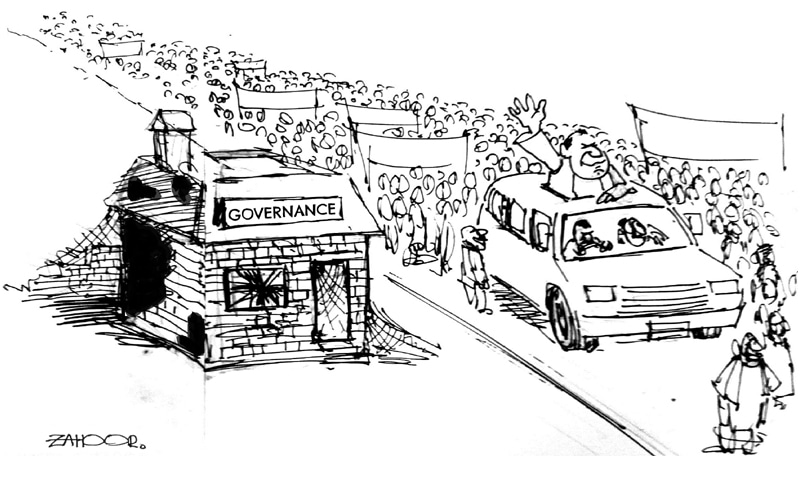
Zahoor's Cartoon
"گڈ گورننس"
نواز شریف حکومت "گڈ گورننس" کے بلند و بانگ دعو ے کرتے نہیں تھکتی اور اس بات پر ہمیشہ زور دیتی رہی ہے کہ یہی گورننس ہے جو انہیں دوسری جماعتوں کی حکومتوں سے ممتاز کرتی ہے مگ؛
1. کیا بجلی کے شعبے میں سرکلر ڈیبٹ کا 800 ارب ہو جانا " گڈ گورننس " ہے؟
2. پاکستان کے تجارتی خسارہ کا 30 ارب ڈالر سے زائد تک جا پہنچنا " گڈ گورننس " ہے؟
3.غیر ملکی قرضہ جات کا 80 ارب ڈالر کے قریب پہنچ جانا " گڈ گورننس " ہے؟
4. بجلی کی پیداوار کے ناکام منصوبے اور اگست کے مہینے میں ملک میں بد ترین لوڈ شیڈنگ " گڈ گورننس " ہے؟
5. تاجروں کی حمایت کھو دینے کے خوف سے براہ راست ٹیکس وصولی میں ناکامی کے بعد عوام پربالواسطہ ٹیکسز کا بوجھ ڈالنا " گڈ گورننس " ہے؟
6. 40 فیصد عوام کا خط غربت کی سطح سے نیچے زندگی گزارنا اور ان کے حالات بدلنے کے لئے کوئی جامع منصوبہ نہ ہونا ،" گڈ گورننس " ہے؟
7. تمام تر اخراجات، بیرونی امداد اور منصوبوں کے باوجود اسکولوں میں " نیٹ ان رول منٹ ریٹ" میں کمی بھی شاید " گڈ گورننس " ہے؟
8.پاکستان پانی کی کمی کا شکار ہونے والے ممالک کی فہرست میں شامل ہونے جا رہا ہے ، اس حوالے سے کسی ایک بھی جامع منصوبہ کا آغاز نہ ہونابھی " گڈ گورننس " ہی ہے؟
9.کیا ہمارے لئے یہ سوال اٹھانا زیادہ اہم نہیں کہ سی پیک معاہدہ کی شرائط کیا ہیں اور چین کو منصوبے سے پہلے اور بعد کیا مراعات دی گئی ہیں؟
10.شاید ہمارے ملک میں نہ کسی نے سری لنکا کو قرضہ دے کر اس کی پورٹ پر چینی قبضے کی کہانی پڑھی ہے اور نہ ہی کسی کو اس میں دلچسپی ہے۔
11. اس ملک میں ہمارے بچوں کا مستقبل پانی کے بغیر کیا ہو گا اس سے بھی ہمارا کوئی تعلق نہیں-
ان سوالات کا تعلق براہ راست پاکستان کے مستقبل سے ہے۔ میں حیران ہوں کہ پی ٹی آئی جیسی جماعت بھی جو بھرپور اپوزیشن کا دعویٰ کرتی ہے، ان معاملات پر نہ تو سنجیدگی سے سوالات اٹھاتی ہے اور نہ ہی حقائق کو پاناما کیس جتنےزور و شور سے عوام کے سامنے پیش کرنے کی کوئی کوشش کرتی ہے۔ ۔
(افتخار احمد , شطرنج، مہرے اور تماشائی،اقتباس  ، jang.com.pk , August 12, 2017)
..........................................................
گڈ گورننس


گڈ گورننس کا فقدان ہمارے ملک کا ایک اہم ترین مسئلہ بن چکا ہے لیکن اس مسئلے کو اب بھی سنجیدگی سے نہیں لیا جارہا ہے، حالانکہ اس مسئلے سے دیگر اہم مسائل بھی جنم لے رہے ہیں، مثلاً آج کل ذرایع ابلاغ پر نمایاں ترین مسئلے یعنی سندھ میں رینجرز کے اختیارات کے مسئلے کا تعلق بھی اس سے ہے۔
اگر سندھ میں گڈ گورننس ہوتی تو پھر یہاں کسی بڑے آپریشن اور رینجرز کے بلانے کی ضرورت بھی نہیں رہتی۔ پاکستان ہو، اس کا کوئی صوبہ ہو یا کہ کسی صوبے کا کوئی ادارہ ہو، تمام جگہوں پر گڈ گورننس تقریباً ختم ہوچکی ہے۔ ہمارے وزیراعظم غریبوں کے علاج کے لیے کارڈ اسکیم کا اعلان کررہے ہیں۔ یقیناً یہ اچھی بات ہوگی مگر سرکاری اسپتالوں میں گڈ گورننس کب قائم ہوگی؟ وہ کب حقیقی معنوں میں فعال ہوں گے؟ کیا ہم نے کبھی غور کیا کہ آخر گڈ گورننس کی راہ میں کیا رکاوٹ ہے؟ اور اس مسئلے کا حل کیا ہے؟ یہ کوئی راکٹ سائنس نہیں، اس کا سیدھا سادہ سا حل ہے، آئیے اس پر غور کریں۔
سب سے پہلے کسی بھی ادارے کے سربراہ کا انتخاب میرٹ پر کیا جائے، نہ کہ سیاسی تعلق کی بنیاد پر یا پھر محض نوازنے کے لیے۔ نوازنے کے لیے کوئی اور طریقہ دریافت کیا جائے بجائے کسی قسم کی وزارت یا کسی ادارے کی سربراہی سونپنے کے۔ یہ بات تو کوئی راز ہی نہیں ہے کہ نوازنے کے لیے دی جانے والی ذمے داری سے ہر بڑا آدمی صرف ’’کمانے‘‘ کا کام کرتا ہے، نہ کہ اپنی ذمے داری کو ایمانداری سے نبھانے کی کوشش کرتا ہے۔ یہ کام خاصا مشکل ضرور ہے مگر ناممکن تو نہیں۔

یہ سوال بڑا اہم ہے کہ آخر ہماری حکمراں جماعتوں کو اپنی وزارتوں اور کسی بھی ادارے کے سربراہ کی تقرری کے وقت خود اپنی ہی جماعت میں کوئی باصلاحیت اور ایماندار آدمی کیوں نہیں ملتا؟ اور اگر نہیں ملتا تو کیا کوئی غیر جانبدار شخص بھی نہیں ملتا؟ زیادہ دور کی بات نہیں پچھلی حکومت میں ریلوے کے پورے نظام کو تلپٹ کرکے رکھ دیا گیا تھا، لیکن آج ایک صحیح شخص کے انتخاب نے ریلوے کو پاکستان سے نہ صرف ختم ہونے سے بچایا بلکہ اب یہ ادارہ مزید ترقی اور بہتری کی جانب گامزن ہے (یہاں راقم بحیثیت ایک پاکستانی سعد رفیق اور ن لیگ کو شاباش کہنا چاہے گا کہ انھوں نے ایک بہترین فیصلہ کیا اور پھر عمل بھی کرکے دکھایا)۔
گڈ گورننس قائم رکھنے میں نیب جیسے ادارے اہم کردار ادا کرسکتے ہیں اور اس کا طریقہ نہایت آسان ہے مگر مشکل بھی۔ آسان اس طرح ہے کہ اس قسم کے ادارے اگر نیک نیتی کے ساتھ صرف اور صرف کسی بھی ادارے کے سربراہ کی مکمل چھان بین کریں کہ وہ ٹیکس کتنا دیتا ہے؟ اس کے اخراجات کیا ہیں؟ اور گزشتہ دس برسوں میں اس کے اثاثے کیا تھے اور اب کیا ہیں؟ اگر تمام اداروں کے سربراہوں کی اس طرح چھان پھٹک کرلی جائے اور بلاتفریق عدالت کے کٹہرے میں لے آیا جائے تو کسی ادارے کے سربراہ کے لیے یہ آسان نہ ہوگا کہ وہ کرپشن کرسکے۔ درحقیقت کرپشن ہی کسی بھی ادارے کو خراب گورننس اور تباہی کی طرف لے جاتی ہے۔ جن اداروں کے سربراہ کرپشن میں ملوث نہ ہوں وہ ادارے ہی ترقی کی طرف گامزن ہوتے ہیں۔
اگر سربراہ ہی کرپٹ ہوجائے تو ظاہر ہے کہ نیچے کا عملہ بھی بہتی گنگا میں ہاتھ دھوتا ہے، جس سے گڈ گورننس تو ایک طرف، ادارہ ہی تباہی کے دہانے پر پہنچ جاتا ہے۔ یہاں ڈاکٹر عبدالوہاب کا تذکرہ بے محل نہ ہوگا، جس وقت جامعہ کراچی میں دوران امتحان نقل کا کلچر زور پکڑ گیا تھا اور گڈ گورننس بری طرح متاثر ہورہی تھی، ڈاکٹر عبدالوہاب نے سختی کے ساتھ نظم وضبط کو قائم کیا اور بہت سی خرابیوں کو جڑ سے اکھاڑ پھینکا، نقل کا کلچر جڑ سے ختم کرادیا، نیز جامعہ میں ایوننگ پروگرام شروع کرایا، آج جامعہ کراچی کے اسٹاف کو تنخواہوں کی ادائیگی ہورہی ہے تو اس ایوننگ پروگرام سے حاصل ہونے والی آمدنی سے، ورنہ تو یہاں کے اساتذہ بھی پاکستان اسٹیل ملز کے ملازمین کی طرح مہینوں مہینوں تنخواہوں سے محروم رہتے۔
کچھ ہی عرصے پہلے ایک اخبار میں یہ خبر شایع ہوئی کہ سندھ میں ایماندار افسران کی کمی ہے، ایک ایک افسر کو کئی کئی ذمے داریاں سونپی جارہی ہیں کیونکہ کرپٹ افسران کسی کارروائی کے خوف سے ملک سے جاچکے ہیں یا جارہے ہیں۔ یہ خبر عیاں کر رہی ہے کہ اس صوبے میں کرپشن کی کیا صورتحال ہے اور گڈ گورننس کس سطح پر ہے۔
مرض کو ابتدائی مرحلے میں توجہ نہ دی جائے تو پھر بڑا آپریشن ناگزیر ہوجاتا ہے۔ سندھ میں آپریشن کا بھی یہی معاملہ ہے، گو قانونی لحاظ سے سندھ حکومت کا موقف اپنی جگہ درست ہے مگر اس حکومت کے ذمے داروں کو یہ سوچنا تو چاہیے کہ عوامی آواز خود یہ محسوس کررہی تھی، اور آج بھی کررہی ہے کہ یہاں کے مرض کا علاج اب بڑا آپریشن ہی ہے۔ کرنے کا کام تو یہ ہے کہ مرض کو دور کرنے کے لیے صوبائی حکومت خود سے بڑا آپریشن کرکے یہاں گڈ گورننس قائم کرے۔
گڈ گورننس کا ایک اور اہم اور بڑا پہلو انصاف کی فراہمی ہے۔ راقم نے ایک بڑے سرکاری افسر سے پوچھا کہ آپ ایماندار افسر ہیں، آپ کوئی بڑا کردار ادا کیوں نہیں کرتے؟ ان کا جواب تھا کہ وہ اپنے طور پر تو یہ کردار ادا کررہے ہیں لیکن ان کی پشت پر کوئی بھی نہیں، ان کا تعلق کسی بھی جماعت یا گروہ سے نہیں، ایسے میں کوئی بڑا کلمہ حق کہنا بہت مشکل ہے، ہاں اگر ہماری عدالتیں اس قدر مضبوط ہوجائیں کہ عوام کا اعتماد ان پر بحال ہوجائے تو ایک میں کیا نہ جانے کتنے ایماندار افسران سر دھڑ کی بازی لگا کر اپنا کردار نبھائیں اور محاذ پر ڈٹ جائیں۔ بلاشبہ انصاف کی فراہمی بھی گڈ گورننس میں ایک اہم کردار ادا کرتی ہے۔
آج راقم سمیت بہت سے لوگوں کے دن رات کا مشاہدہ ہے کہ مختلف اداروں میں جو ایسوسی ایشنز یا یونینز اپنے ادارے کے ملازمین کو حقوق دلوانے کے لیے بنتی ہیں، وہ خود ہی اپنے ملازمین کا سب سے بڑا استحصال کرتی ہیں اور محض اپنے پسندیدہ ملازمین کے کام کرواتی ہیں اور انتظامیہ پر دباؤ ڈال کر غیر قانونی کام کروا کر اپنے بینک بیلنس بناتی ہیں۔
یوں جن تنظیموں کا کام لوگوں کو ان کے حقوق دلوانا ہوتا ہے، ظلم و ناانصافی ختم کرنا ہوتا ہے اور ادارے میں گڈ گورننس قائم کرنا ہوتا ہے ان کی جانب سے خود قانون کی دھجیاں اڑائی جاتی ہیں اور گڈ گورننس کو تباہ کرنے میں کوئی کسر نہیں چھوڑی جاتی۔ ظاہر ہے کہ جب گڈ گورننس کو قائم کرنے کے لیے دباؤ ڈالنے والے الٹا گڈ گورننس ختم کرنے کے لیے دباؤ ڈالیں گے تو پھر ادارے کی انتظامیہ بھی ان کے غیر قانونی کام کرنے کے بعد شتر بے مہار بن جاتی ہے اور ادارے کو ذاتی فوائد حاصل کرنے کے لیے کھل کر نقصان پہنچاتی ہے، کیونکہ اسے پتہ ہوتا ہے کہ اب اسے کوئی روک ٹوک کرنے والا نہیں اور اگر کوئی ہوگا بھی تو اس سے یہ ملازمین کے حقوق دلوانے کے دعویدار خود ہی نمٹ لیں گے۔
راقم کے ایک دوست کا کہنا ہے کہ انصاف اور احتساب وہی کرسکتا ہے جس کا دامن صاف ہو، جب تک قانون نافذ کرنے والے اور انصاف فراہم کرنے والے اداروں میں ایسے لوگوں کی کثرت نہیں ہوجاتی، گڈ گورننس کا قیام آسان نہیں۔ راقم کا خیال ہے کہ ایسے افراد کی ضرورت تو ہر ادارے میں ہے۔ آئیے پہلے اپنا دامن صاف کرنے کی کو شش کریں اور کچھ دیر اس پہلو پر بھی غور کریں۔

......................................................
Image result for ‫گڈ گورننس کیا ہے‬‎

Crisis of Good Governance

nation.com.pk

Governance is the exercise of authority to address public affairs. This authority can be political, economic or administrative. The use of this authority is always based upon certain rules and laws of society established by its members. Good governance is to run administration according to these defined laws for the welfare of the people. Bad governance means digression or subversion from these laws. Good governance guarantees safety and security of the people and creates an atmosphere conducive to progress and prosperity. Bad governance begets a number of social crises. 

Good governance comes through strong and independent institutions of the state. These institutions need to be built, sustained and stronger than individuals. Unfortunately, a little effort has been made to build institutions on a stable footing in Pakistan since independence and individuals have taken precedence over institutions. Pakistan suffers from a number of crises but the crisis of good governance is on top because it is the core of all other problems. 
Our country is suffering from weak institutional set-up, political instability, rampant corruption, lack of accountability and transparency and bad law and order situation. All these issues have seriously pushed off the country to an abysmal state of poor governance. 

Every government looks down upon the policies of the previous government, throws those away and establishes new ones. Due to bad governance education, health, civic services, agricultural infrastructure are all in bad state. Even the most basic social needs of citizens are not fulfilled. Law and ordered situation is deteriorating and people are being robbed and killed in bright day light. People don’t feel safe and secure. 
Places of worship have to be guarded for the fear of terrorism. This sorry state of law and order scare the investors away from the country thereby severely harming the economy. 
One of the most damaging effects of bad governance is the prevalence of corruption that ultimately results in lawlessness and the biggest hindrance in the way of development. The absence of impartial and independent accountability has resulted in the growth of this monster. It has become a norm in our society rather than an exception. 

Good Governance stands for poverty alleviation. 
It has always been a favourite buzzword in our economic and social development circles. 
Almost every democratic government has launched poverty reduction programs but all proved futile and ended in corruption. Accountability is a crucial point in good governance – the rulers and the institutions of the state are accountable to people. But, it is very hard to find it in Pakistan’s weak institutional set-up. 

Merit or fairness is essential for good governance and the both support each other. But in our country merit is given least importance. Nepotism and favouritism are the order of the day. Our once very strong institutions like PIA, Pakistan Railway, Pakistan Steel etc. are now in state of paralyse.  All the cities in any province is not getting equal share of development. 
Developing one city in any province at the cost of basic facilities, like hospitals, schools and colleges, clean drinking water etc. , of the other cities is another example of bad governance. One city gets the road network, underpasses and overhead bridges and the others don’t have the basic road network. This disparity has created bad feelings among people living in small cities. 
Similarly, unemployment, illiteracy are other aspects which speak volume about sorry state of governance. People at the helm of affairs need to understand that good governance is more than mere management.  It is not only about decision making, policy formulating but also priority settings, implementation and getting results. Transparency, legitimacy, merit and the rule of law are the important pillars of good governance. 
Politicians and other state officials in the power corridor make illegal appointments in various public offices. They could appoint inept people without merit on political grounds, for the sake of money, favouritism and nepotism. 

The civil servants, police and NAB are not fully autonomous in their decree to work. All are under severe political pressure. None of them is granted full independence, to bring the criminals to justice and inquire the cases of big guns. These are powerful institutions, which need considerable attention to de-politicise their structures. These institutions should be given absolute autonomy to bring the corrupt people before the law. 

Good governance is a prerequisite for social harmony, public order, political stability, economic prosperity and certainty about future. It delivers the fruit of progress and development evenly to all and sundry. Good governance is required at all levels of society and state. Government needs to focus seriously on this issue to accomplish satisfactory results. We must not allow the erosion of institutions through the idiosyncratic behaviour of rulers. No state is free of all crises but it is the quality of governance that ensures its survival through any crisis. 

Rauf  A Khattak , The writer is based in Lahore. 
http://nation.com.pk/columns/05-Mar-2017/crisis-of-good-governance

.
~ ~ ~ ~ ~ ~ ~ ~ ~ ~ ~ ~ ~ ~ ~ ~ ~  ~ ~ ~  ~


~ ~ ~ ~ ~ ~ ~ ~~ ~ ~ ~ ~ ~  ~ ~ ~  ~
Humanity, Knowledge, Religion, Culture, Tolerance, Peace
انسانیت ، علم ، اسلام ،معاشرہ ، برداشت ، سلامتی 
Books, Articles, Blogs, Magazines,  Videos, Social Media
بلاگز، ویب سائٹس،سوشل میڈیا، میگزین، ویڈیوز,کتب
سلام فورم نیٹ ورک  Peace Forum Network 
Join Millions of visitors: لاکھوں وزٹرز میں شامل ہوں 
Salaamforum.blogspot.com 
سوشل میڈیا پر جوائین کریں یا اپنا نام ، موبائل نمر923004443470+ پر"وہٹس اپپ"یا SMS کریں   
Join 'Peace-Forum' at Social Media, WhatsApp/SMS Name,Cell#at +923004443470
     
  
Facebook: fb.me/AftabKhan.page

Democracy’s woes


OVER 2,000 years ago, Plato was sceptical of democracy because he felt that voters, even though restricted to property-owning male citizens, were swayed easily by the rhetoric of politicians.
Democracy disappeared for over 1,500 years following its demise in Athens and it was only then that its slow evolution began in England and spread to other parts of the world. Doubts regarding its efficacy persisted but were countered by arguments that it was the worst form of government except for all others.
Not that this was considered universally applicable. During colonialism it was asserted that natives were not ready for democracy. Similar reservations regarding the developing world persisted beyond the end of colonialism. In the 1990s, the late Richard Hol­brooke was reported to have said: “Suppose elections are free and fair and those elected are racists, fascists, separatists — that is the dilemma.”
We rightly attribute these attitudes to the realpolitik that rationalised empire-building and later interventions to replace democratic governments with pliant authoritarian ones. They were just as self-serving as their more recent converse — regime-change with the professed aim of promoting democracy.
Nevertheless, the intellectual challenge to democracy was unaddressed — after all Hitler was popularly elected and voters have often elected leaders who they themselves condemn as thieves and rascals. Genuine doubts regarding the capacity of the electoral process to yield competent leadership remain and the democratic experiment is not old enough to argue unequivocally that the case is closed.
A review of the rules underpinning the poll process is needed.
The revival of this debate is due to the turmoil in the democratic homeland — governmental gridlock, the surge in extremist sentiment in Europe, and the emergence of Trump as a presidential candidate in the US. As one comment put it: “With a vain fool like Trump on the political stage in America and racist bigots and know-nothings voting all over the world it’s a good time to ponder the wisdom of the political systems that allow this to happen.”
In this context, political theorist Daniel Bell has made waves with his book, The China Model: 

The China Model: 
Political Meritocracy and the Limits of Democracy, in which he questions the article of faith that one-person-one-vote is the best way of selecting leaders. He offers as a credible alternative the still-evolving Chinese model based on democratic local elections and meritocratic selection of top national leaders. In this system, local leaders handling basic issues of service delivery remain accountable to voters but national leaders who need to make complex and unpopular decisions are chosen based on knowledge and experience.

Similar reservations about democratic decision-making have been expressed more recently by Richard Dawkins with reference to the UK referendum on EU membership.  Dawkins asks: “How should I know? I don’t have a degree in economics. Or history. How dare you entrust such an important decision to ignoramuses like me... You want your surgeon to know anatomy… Why would you entrust your country’s economic and political future to know-nothing voters like me?”
Heated exchanges on the relative merits of Western and Asian values erupted a few decades back in the wake of the East Asian crisis but the self-serving claims lacked objectivity. The challenge from scholars like Bell and Dawkins carries more legitimacy because they do not have political or economic interests at stake.
The point here is not to assert that democracy in Pakistan should be replaced by military dictatorship or monarchy. Rather, it is to urge a critical examination of the rules underpinning the electoral process by which leaders are selected and made accountable. Much has changed since the birth of democracy in England — corporations more powerful than many countries did not exist then and neither did the means of swaying voters now available. With the visible transition of democracy to plutocracy in the US and the dangerous manipulation of extremist sentiments, it is obvious that reforms are required to repair the systemic distortions that have accrued over time.
Electoral systems are nothing more than sets of rules. Consider some that exist in the US — primaries to select party candidates, first-past-the-post elections, super delegates with decisive power, the Electoral College, and treatment of corporations as individuals. Change any of these and the outcomes may be different. At the same time, failure to agree on rules can have tragic outcomes as witnessed in the Indian subcontinent in 1947.
Debates are structured around ideas and critical ideas are nurtured in schools and colleges that have failed to do an adequate job in Pakistan. It is no wonder that our popular discourse remains mired in a simplistic choice between democracy and dictatorship ignoring the hard work of assessing the set of electoral reforms that would improve governance and promote leaders that are more competent and accountable to citizens.
Democracy’s woes
by Anjum Altaf, dawn.com
The writer moderates the South Asian Idea, a learning resource for college students. http://www.dawn.com/news/1267272/democracys-woes

Democracy’s woes  by Anjum Altaf, dawn.com. The writer moderates the South Asian Idea, a learning resource for college students. http://www.dawn.com/news/1267272/democracys-woes


Read more by Plato:     
As a just and healthy person is governed by knowledge and reason, a just society must be under the control of society’s most cultivated and best informed minds, its “lovers of wisdom.” Just societies cannot be run by big money or armed forces with their too narrow agendas. Limitless desire for wealth and blind ambition must be watched and contained as potential public dangers. The most informed minds must determine objectively, with due consideration of all points of view, what the most healthy and practical goals for the commonwealth are.》》》》  http://faculty.frostburg.edu/phil/forum/PlatoRep.htm

The collapse of state institutions

Historically the state institutions and bureaucrats were always completely under the control of the ruler.  They were neither professionals nor well trained; therefore, the working of the institutions were not efficient. All efforts were devoted to please the King instead of finding solutions to problems of the common people.

In this way, China, however, differed from other countries as here bureaucrats were selected for high government offices and a competitive system was introduced to recruit talented youth who would sit examinations and only after passing these would they be appointed as high officials or absorbed into the aristocracy and thereby assume the privileged status.

In a democratic system, the whole situation changes because this system ended the monopoly of aristocracy who were replaced by those who had merit and intelligence. It affected the working of the administration because the officials were now loyal to the state and not the rulers. During the colonial rule in India, the British Government introduced the competitive examination system for civil servants in the subcontintent who were responsible for administering government affairs throughout the British rule.

These bureaucrats reputed as honest and incorruptible maintained the control of the Raj and worked efficiently. As a result, these colonial institutions sustained the authority of the British over India.

In countries where the democratic system is stable and strong, state institutions are independent to govern the country. Generally in elections, people elect their leaders not only based on merit but also on propaganda and popularity. In the presence of mediocre leadership, the state institutions continue to run the affairs of the country uninterrupted.

Mediocrity can only be adjusted if the state institutions are strong and efficient.

In case of Pakistan, we inherited colonial state institutions in which the office holders are selected on the basis of their high merit and intelligence.

However, gradually our ruling classes distorted the working of these institutions, when competitive examinations and their high standard was deteriorated through lateral entry of individuals appointed from outside on the basis of sycophancy, nepotism and favouritism which polluted the working of these institutions.

At present, Pakistan is facing crisis after crisis as neither the state institutions are competent to check the deterioration and decay, nor the society and the mediocre, elected leadership has any vision or foresight to understand the complex problems of the country. Moreover, state institutions are serving the interest of the ruling classes instead of the people. They collaborate with dictators and corrupt political leadership, rendering damage to their own integrity and causing unrest and distress among the people; and when they fail to respond to the challenges of the time, the future of the country appears hopeless. Democracy could be useful only when politicians and the state institutions follow the policy of merit. 

Related:
~ ~ ~ ~ ~ ~ ~ ~ ~ ~ ~ ~ ~ ~ ~ ~ ~  ~ ~ ~  ~
Humanity, ReligionCultureSciencePeace
 A Project of 
Peace Forum Network
Peace Forum Network Mags
BooksArticles, BlogsMagazines,  VideosSocial Media
Overall 2 Million visits/hits

Bad Governance & Democracy

Image result for bad democracy quotes
Let me start with the famous remark made by Winston Churchill on democracy: “Indeed it has been said that democracy is the worst form of government except for all those other forms that have been tried from time to time.” It is quite common in Pakistan to see people complaining against democratic governments over every major or minor issue. There is widespread public disappointment with the performance of governments today, but this has always been the case whenever we have had elected governments. Let us acknowledge, with open minds, that dynastic leaders, parties, the electoral elite, political families and powerful political groups, in every region of Pakistan, have very few achievements and little success to show to the public. They are long and strong on rhetoric and very short and weak on performance.
Image result for bad democracy quotes

One more thing in our social and democratic context is very important, which is also true for other Muslim majority societies, i.e., the solid connection between misrule and rise of extremism, terrorism and militant ethno-nationalism. Misrule is perhaps a polite and benign expression for the massive plunder of Pakistan by the ruling elite, often elected on the strength of illegal monies and strong political networks they have created. Most of the ruling elite have little respect for the people of this land or any real interest in the development of this society. They are here for the easy money they can make and when the going gets a little tough, they escape to their safe havens abroad — and live in peace, prosperity and happiness.

The rise of radicalism in every Muslim society has been a real cause of the neglect of education, rule of law, good universal values and governance. Unlawful behaviour of the elite and the immunity they enjoy through their power and political clout, have in turn produced many forms of illegalities in society. The deterioration of values, decline of institutions and weakening of laws and their implementation have spread to every part of society. Political catchwords like ‘we have done nothing wrong’ and ‘no court has convicted us’ tell us more about the failure of the system of accountability than the innocence of all famous and infamous political players of the country. Their conduct in power has created a vacuum of ethical legitimacy that has been effectively exploited by radical ideology, which argues that the failure of the ruling elite is actually the ‘failure’ of Western democracy, and that elected public figures are nothing but ‘tools’ of Western powers.

Add to this pervasive social discourse and popular narratives at the lower levels of society is the problem posed by our young population that is without adequate, let alone good education, and has limited employment opportunities and avenues for personal progress. Indeed, these are all serious problems that may continue to pull Pakistan down. Ignoring these problems, which are often associated with democracy and ‘democrats’, is not an option anymore.

What is the alternative to bad democracy? Frankly speaking, none. After four military interventions and more than four democratic movements as well as the restoration of the Constitution, democracy has emerged as a ‘default position’ for Pakistan. Our institutional endowment for democracy is far stronger than any other Muslim state’s, and we have a long history of development of political and state institutions going back to colonial times.

We have the means to improve conditions under democratic rule, and we know how others have transformed bad democracies into good ones. Chief among them is public awareness, which is better than before. We have laws and institutions that need to be strengthened and should be made to work in the areas of accountability and rule of law. Pakistan’s future progress, order, stability and coherence depend on good democracy.
By Rasul Bakhsh Rais: The writer is a professor of political science at LUMS
http://tribune.com.pk/story/997619/living-in-a-bad-democracy/
~~~~~~~~~~~~~~~~~~~~~~~~~~~~~~~~~~~~~~~~~

Fuss over good governance:

Image result for bad democracy quotes
By Imtiaz Gul:
The Pakistani media has been awash with heated debates over the ‘unconstitutionality’ of the concerns on good governance that General Raheel Sharif conveyed during the November 10 Corps Commanders’ conference. Opposition members of parliament pounced upon the army chief’s advice in order to settle scores with the government. The discourse in the media clearly stemmed from the civilian government’s displeasure over the advice coming from a “constitutionally subordinate institution”.

But was this really something unusual given Pakistan for decades has been guided by the military establishment and an erratic, self-serving civilian ruling elite? Certainly not. So, why all the fuss? Let us first see how the UN Economic and Social Commission for Asia and the Pacific defines good governance. It describes it as “decision-making by which decisions are implemented (or not implemented)”. It also identifies eight major characteristics that constitute good governance: a system that is participatory, consensus-oriented, accountable, transparent, responsive, effective and efficient, equitable and inclusive, and follows the rule of law. It assures that corruption is minimised, the views of minorities are taken into account and that the voices of the most vulnerable in society are heard in decision-making. Can the federal and provincial governments claim they are following all or some of these ingredients of good governance? The answer is largely in the negative on many counts.

Despite Finance Minister Ishaq Dar’s rosy projections, Pakistan is ranked a lowly 138 out of 189 countries on the World Bank’s Doing Business 2016 ranking. Has the government elevated or jolted the confidence of multinationals already operating in a fragile situation? We understand that the FBR is acting like a ‘robber baron’ to extract funds for its IMF-dictated resource mobilisation campaign. In a high-handed, unbecoming manner, individuals and businesses are being asked to cough up funds to meet IMF demands. This state of affairs will certainly not encourage foreign investments, nor will other countries remove travel advisories for those of their citizens intending to visit Pakistan.

The recent Midterm Report Card for Members of National Assembly (MNA), launched by Alif Ailaan, states that only three out of a total of 272 elected MNAs managed an overall ‘A’ grade in the scorecard for progress in terms of school facilities, student retention, gender parity and the student-teacher ratio in public schools of their constituencies. So much for the democrats’ love and commitment to education! Has the Model Town case of 2014 or the Kasur child sexual abuse case been resolved to the satisfaction of the aggrieved? What steps have been taken so far to review and amend the dated Criminal Procedure Code or the 1861 Police Act — both being at the root of low conviction rates, heavy pendency and unreasonably protracted trials often to the disadvantage of the poor and the victims?

Has the Punjab government followed principles of transparency, fairness and the rule of law when approving funds for the Orange Line project or for the security of the Sharif family in Jati Umra? Removal of reluctant government officials and replacing them with yes men certainly doesn’t bespeak good governance. Hospitals, even in provincial and federal capitals, are extremely short on critical, life-saving vaccines and equipment, such as ventilators. Hospital administrations have to wait for months to get petty amounts approved, while pregnant women are forced to give birth on the stairs of hospitals. On the other hand, the bureaucracy and chief ministers hardly waste a minute in approving tens of millions for their own security, with some 2,751 police officials already in the service of the entire Sharif family. Is this good governance? Has the government transparently resolved fiascos such as the Quaid-e-Azam Solar Park and Nandipur project? Or do ‘democrats’ believe that the poor man’s vote makes them accountable for their deeds?

The list of such questions is endless and this obligates civilian rulers to handle the poor man’s trust, i.e., votes, with some sincerity. All stakeholders — politicians, bureaucracy, the military, media and the civil society — are supposed to raise concerns when there are administrative lapses and legal deviations, more so in a culture where abuse of power and deviation from the rule of law are norms. Votes from the public do not give our rulers the carte blanche for arbitrary and self-serving governance. Questions, like the ones raised by General Raheel, will continue to be asked as long as rulers continue to abhor the rule of law and transparency.
The writer heads the independent Centre for Research and Security Studies, Islamabad and is author of Pakistan: Pivot of Hizbut Tahrir’s Global Caliphate
http://tribune.com.pk/story/997587/fuss-over-good-governance/

~ ~ ~ ~ ~ ~ ~ ~ ~ ~ ~ ~ ~ ~ ~ ~ ~  ~ ~ ~  ~
Humanity, ReligionCultureSciencePeace
 A Project of 
Peace Forum Network
Books, Articles, BlogsMagazines,  Videos, Social Media
Overall 2 Million visits/hits
http://JustOneGod.blogspot.com
~~~~~~~~~~~~~~~~~~~~~~